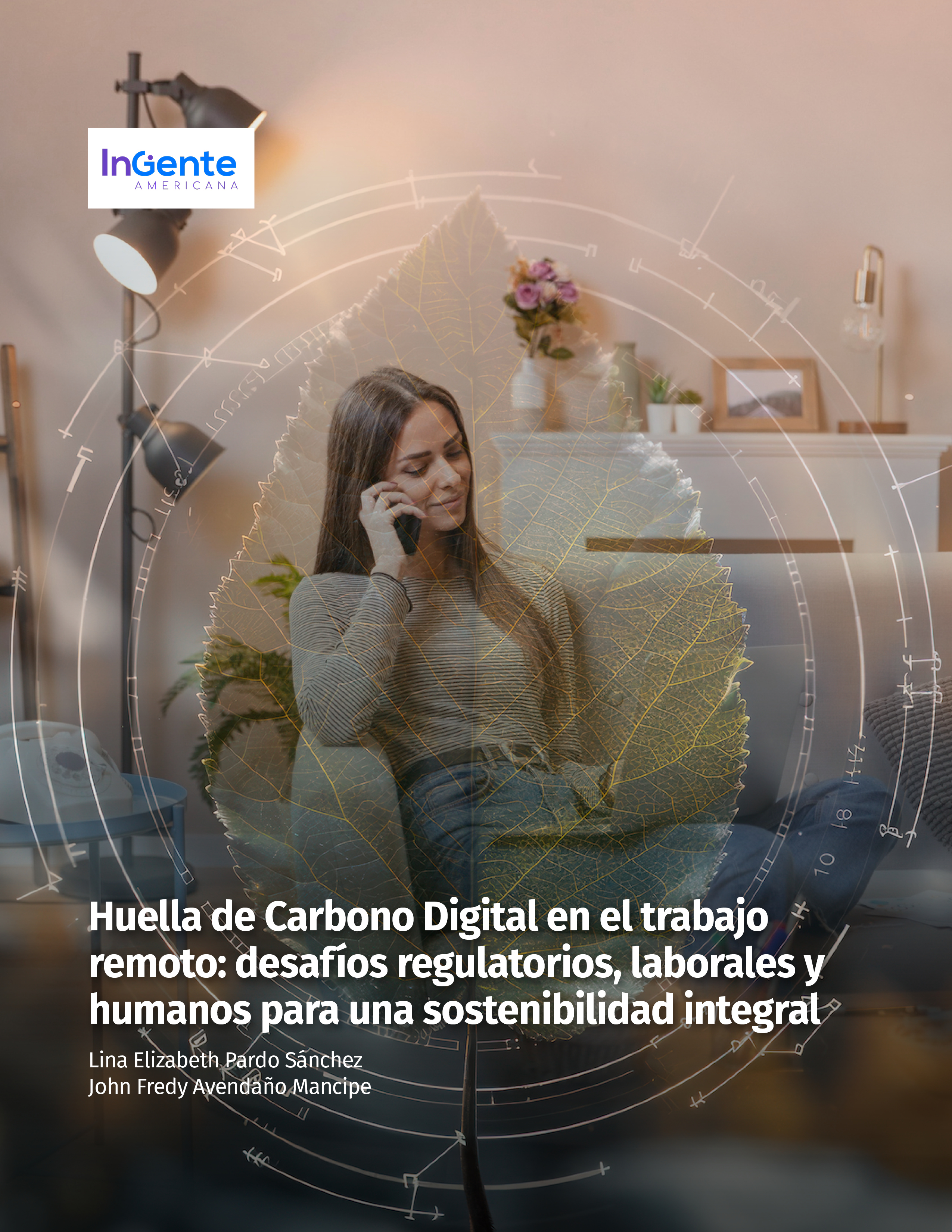
Digital Carbon Footprint in Remote Work: Regulatory, Labor and Human Challenges for Integral Sustainability
DOI:
https://doi.org/10.21803/ingecana.5.5.948Keywords:
Digital carbon footprint, Emotional intelligence, Environmental regulation, Digital sustainabilityAbstract
This article analyzes the digital carbon footprint in the context of remote work, considering its relationship with the intensive use of information technologies, the growth of data centers, and the absence of specific regulation in Colombia. A qualitative methodology was applied through a documentary review of academic, regulatory, and technical sources published between 2018 and 2025. The results show a sustained increase in indirect CO₂ emissions derived from everyday digital habits, as well as regulatory gaps and the lack of inclusion of this footprint in environmental planning instruments. In addition, business proposals aimed at digital sustainability are identified, and the emotional dimension of intensive technological use is examined. The article concludes with the need to design public policies, indicators, and practices that incorporate the digital footprint as a key component in the transition toward more comprehensive environmental, organizational, and human sustainability.
Downloads
References
E. Sierra, «Nómadas digitales: digitalización y descarbonización,» 16 enero 2025. [En línea]. Available: https://www.cielolaboral.com/wp-content/uploads/2025/03/sierra_noticias_cielo_n2_2025.pdf.
D. Castañeda, «La nube contaminante. Un análisis socioambiental de la huella de carbono digital,» marzo - agosto 2022. [En línea]. Available: http://www.udgvirtual.udg.mx/paakat/index.php/paakat/article/view/730/pdf_1.
E. B. Agyekum y E. B. Ali, «Impact of technological innovation on carbon neutrality systematic and bibliometric review of two decades of research,» 2025. [En línea]. Available: https://doi.org/10.1007/s44246-025-00197-6. [Último acceso: 03 junio 2025].
C. Sampedro, S. Machuca, D. Palma y B. Villalta, «Impacto ambiental por consumo de energía eléctrica en los Data Centers,» julio 2021. [En línea]. Available: https://dilemascontemporaneoseducacionpoliticayvalores.com/index.php/dilemas/article/view/2786/2804.
Congreso de Colombia, «Ley 1931 – Por la cual se establecen directrices para la gestión del cambio climático,» 27 julio 2018. [En línea]. Available: https://www.minambiente.gov.co/wp-content/uploads/2021/06/ley-1931-2018.pdf.
DNP, «CONPES 3934,» 10 julio 2018. [En línea]. Available: https://colaboracion.dnp.gov.co/cdt/conpes/econ%C3%B3micos/3934.pdf.
R. Attah, B. Patrick y O. Ogunsola, «Advances in Sustainable Business Strategies: Energy Efficiency, Digital Innovation, and Net-Zero Corporate Transformation,» enero 2023. [En línea]. Available: https://www.researchgate.net/profile/Rita-Attah/publication/388425153_Advances_in_Sustainable_Business_Strategies_Energy_Efficiency_Digital_Innovation_and_Net-Zero_Corporate_Transformation/links/67985a718311ce680c3e3b36/Advances-in-Sustainable-Business-St.
Pacto Mundial, «¿Qué son las siglas ASG o ESG?,» s.f.. [En línea]. Available: https://www.pactomundial.org/noticia/la-sostenibilidad-empresarial-desde-las-siglas-asg-o-esg/.
J. Avendaño y W. Pulido, Modelo híbrido para la humanización de la economía empresarial y la responsabilidad social corporativa, Bogotá: Corporación Universitaria Minuto de Dios–UNIMINUTO, 2023.
Y. Guan, Y. Shan, Y. Hang, Q. Nie, Y. Liu y K. Hubacek, «Unlocking global carbon reduction potential by embracing low-carbon lifestyles,» 17 mayo 2025. [En línea]. Available: https://www.nature.com/articles/s41467-025-59269-1. [Último acceso: 02 junio 2025].
A. Haryanto, A. D. Santoso, M. Hanif, I. M. Ihsan, R. Oktivia, J. Prayitno, A. C. Tridakusumah, V. Pebriyanti, S. Triyono, H. Daulay, N. Irawati, M. I. Mawardi, S. Sundari, L. P. Panggabean y C. Indrawanto, «Strategies for sustainable behavior and emission reduction through individual carbon footprint analysis,» 04 junio 2025. [En línea]. Available: https://doi.org/10.22034/gjesm.2025.01.15. [Último acceso: 09 junio 2025].
P. Bardoult, E. Cadic, O. Brichory, V. Marie, C. Rouxel, C. Millet, M. Daudin, E. Peguet y N. Massart, «Which carbon footprint for my ICU? Benchmark, hot spots and perspectives,» 2025. [En línea]. Available: https://link.springer.com/content/pdf/10.1186/s13613-025-01445-z.pdf?getft_integrator=scopus. [Último acceso: 09 junio 2025].
Instituto de Recursos Mundiales, «Protocolo de Gases Efecto Invernadero,» 1998. [En línea]. Available: https://ghgprotocol.org/sites/default/files/standards/protocolo_spanish.pdf.
M. Kaşıkçı, Y. Bağcı, Z. Yıldırım y U. A. Nacak, «Conciencia de la huella de carbono de los estudiantes de enfermería: un estudio cualitativo,» 31 marzo 2025. [En línea]. Available: https://link.springer.com/content/pdf/10.1186/s12912-025-03021-z.pdf. [Último acceso: 08 junio 2025].
J. Brito, G. Hernández y C. Elizalde, «Análisis Teórico-Conceptual de la Huella de Carbono,» marzo-abril 2025. [En línea]. Available: https://ciencialatina.org/index.php/cienciala/article/view/17077/24544.
S. Çam, M. Fatih y T. Bayır, «Understanding green consumption: exploring the role of socially responsible attitudes in sustainable buying behavior,» 06 mayo 2025. [En línea]. Available: https://link-springer-com.ezproxy.uniminuto.edu/article/10.1007/s43621-025-01223-8. [Último acceso: 07 junio 2025].
Downloads
Published
Issue
Section
License
Copyright (c) 2025 Lina Elizabeth Pardo Sánchez, John Fredy Avendaño Mancipe

This work is licensed under a Creative Commons Attribution 4.0 International License.