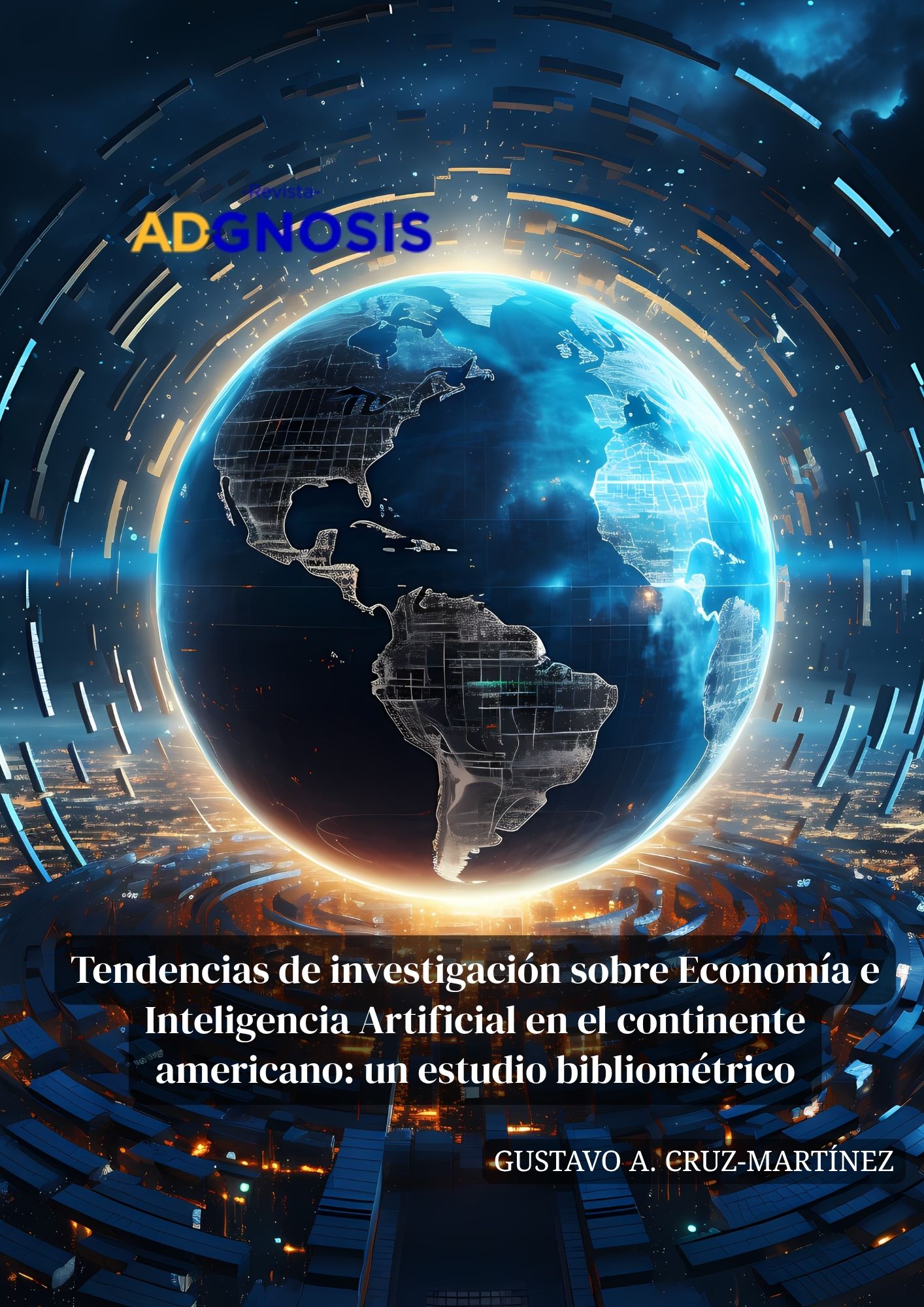
Tendencias de investigación sobre Economía e Inteligencia Artificial en el continente americano: un estudio bibliométrico
DOI:
https://doi.org/10.21803/adgnosis.15.18.1058Palabras clave:
Inteligencia artificial , Análisis económico, Bibliometría, Cambio tecnológico , América LatinaResumen
Introducción: La inteligencia artificial (IA) se ha consolidado como una tecnología estratégica con profundas implicaciones para la economía global. En el continente americano, el estudio de su relación con la economía ha crecido de forma sostenida, reflejando su influencia en los modelos productivos, organizacionales y de decisión. Objetivo: Analizar la producción científica sobre la relación entre economía e inteligencia artificial en América mediante un estudio bibliométrico. Metodología: Se desarrolló una investigación de enfoque inductivo y bibliométrico basada en artículos indexados en Scopus, publicados entre 1985 y 2025. Se analizaron indicadores de productividad científica, colaboración y tendencias temáticas, utilizando VOSviewer para la visualización de redes de coautoría y co-ocurrencia. Resultados: Se identificaron 358 artículos provenientes de 12 países del continente, con un crecimiento notable a partir de 2016. La producción científica se concentra en pocos autores y revistas, lo que evidencia un campo aún en consolidación. Las principales líneas temáticas se vinculan con la digitalización, la sostenibilidad, la economía circular y las tecnologías emergentes. Asimismo, se observa colaboración internacional relevante, aunque con baja representación de algunos países latinoamericanos. Conclusiones: La IA se posiciona como un factor clave en la transformación de los modelos económicos y organizacionales en América. Persisten brechas regionales en la producción científica, lo que evidencia la necesidad de fortalecer la investigación en contextos aún poco explorados.
Descargas
Referencias
Agrawal, A., Gans, J., & Goldfarb, A. (2020). Máquinas predictivas: La sencilla economía de la inteligencia artificial. Reverté-Management. https://dokumen.pub/maquinas-predictivas-prediction-machines-spanish-edition-la-sencilla-economia-de-la-inteligencia-artificial-1nbsped-8494949381-9788494949388.html
Agrawal, R., Wankhede, V., Kumar, A., Luthra, S., & Huisingh, D. (2022). Progress and trends in integrating Industry 4.0 within Circular Economy: A comprehensive literature review and future research propositions. Business Strategy and the Environment, 31(1), 559-579. https://doi.org/10.1002/bse.2910
Baskerville, R., & Dulipovici, A. (2006). The theoretical foundations of knowledge management. Knowledge Management Research and Practice, 4(2), 83-105. https://doi.org/10.1057/palgrave.kmrp.8500090
Budhwar, P., Chowdhury, S., Wood, G., Aguinis, H., Bamber, G., Beltran, J., . . . al., e. (2023). Human resource management in the age of generative artificial intelligence: Perspectives and research directions on ChatGPT. Human Resource Management Journal, 33(3), 606-659. https://doi.org/10.1111/1748-8583.12524
Cañigueral, A. (2016). Definición y evolución de la economía colaborativa. Oikonomics, 6, 16-27. https://www.redalyc.org/pdf/174/17405602.pdf
Choudhury, P., Starr, E., & Agarwal, R. (2020). Machine learning and human capital complementarities: Experimental evidence on bias mitigation. Strategic Management Journal, 41(8), 1381-1411. https://doi.org/10.1002/smj.3152
Cruz-Martínez, G., Cruz-Martínez, D., & & Acevedo-Duque, A. (2024). Bibliometric analysis of technology readiness and education in high-impact journals of social sciences. Journal of Management and Business Education, 7(2), 357-378. https://doi.org/10.35564/jmbe.2024.0020
Dauvergne, P. (2022). Is artificial intelligence greening global supply chains? Exposing the political economy of environmental costs. Review of International Political Economy, 29(3), 696-718. https://doi.org/10.1080/09692290.2020.1814381
Demirkan, H., & Delen, D. (2013). Leveraging the capabilities of service-oriented decision support systems: Putting analytics and big data in cloud. Decision Support Systems, 55(1), 412-421. https://doi.org/10.1016/j.dss.2012.05.048
Furman, J., & Seamans, R. (2019). AI and the economy. Innovation Policy and the Economy, 19(1), 161-191. https://doi.org/10.1086/699936
Hirsch, J. E. (2005). An index to quantify an individual's scientific research output. 102(46), 16569-16572. https://doi.org/10.1073/pnas.0507655102
Holford, W. (2019). The future of human creative knowledge work within the digital economy. Futures, 105, 143-154. https://doi.org/10.1016/j.futures.2018.10.002
Holmes, W., Zhang, H., Miao, F., & Ronghuai, H. (2022). Inteligencia artificial y educación: guía para responsables de políticas. UNESCO. https://unesdoc.unesco.org/ark:/48223/pf0000379376
Huang, M.-H., Rust, R., & Maksimovic, V. (2019). The Feeling Economy: Managing in the Next Generation of Artificial Intelligence (AI). California Management Review, 61(4), 43-65. https://doi.org/10.1177/0008125619863436
Jobstreibizer, J., Beliaeva, T., Ferasso, M., Kraus, S., & Kallmuenzer, A. (2025). The impact of artificial intelligence on business models: a bibliometric-systematic literature review. Management Decision, 63(13), 372-396. https://doi.org/10.1108/MD-10-2024-2309
Kenney, M., & Zysman, J. (2020). The platform economy: Restructuring the space of capitalist accumulation. Cambridge Journal of Regions, Economy and Society, 13(1), 55-76. https://doi.org/10.1093/cjres/rsaa001
Klaus, P., & Zaichkowsky, J. (2020). AI voice bots: a services marketing research agenda. Journal of Services Marketing, 34(3), 389-398. https://doi.org/10.1108/JSM-01-2019-0043
Lotka, A. (1926). Calculus with Analytic Geometry. En The frequency distribution of scientific productivity (Vol. 16). J. Wash. Acad. Sci. https://books.google.hn/books?hl=es&lr=&id=gJlAOiCZRnwC&oi=fnd&pg=PR16&ots=W63AZ__TCs&sig=EGz1a6BI8qNFTkMYHxvaACiQBDo&redir_esc=y#v=onepage&q&f=false
McCarthy, J., Minsky, M. L., Rochester, N., & Shannon, C. E. (1955). A proposal for the Dartmouth summer research project on artificial intelligence. AI Magazine, 27(4). https://doi.org/10.1609/aimag.v27i4.1904
Meng, K., Xu, G., Peng, X., Youcef-Toumi, K., & Li, J. (2022). Intelligent disassembly of electric-vehicle batteries: a forward-looking overview. Resources, Conservation and Recycling, 182(106207). https://doi.org/10.1016/j.resconrec.2022.106207
Mirowski, P. (2007). Markets come to bits: Evolution, computation and markomata in economic science. Journal of Economic Behavior and Organization, 63(2), 209-242. https://doi.org/10.1016/j.jebo.2005.03.015
Moreira, S., & Dallavalle, S. (2024). Unraveling the trends in business process management: a comprehensive bibliometric analysis of management and business literature. Business Process Management Journal, 30(7), 2541-2563. https://doi.org/10.1108/BPMJ-10-2023-0771
Nilsson, N. (1985). Artificial intelligence, employment, and income. Human Systems Management, 5(2), 123-135. https://doi.org/10.3233/HSM-1985-5205
Pamucar, D., Deveci, M., Gokasar, I., Tavana, M., & Köppen, M. (2022). A metaverse assessment model for sustainable transportation using ordinal priority approach and Aczel-Alsina norms. Technological Forecasting and Social Change(121778). https://doi.org/10.1016/j.techfore.2022.121778
Pinheiro, M., Jugend, D., Lopes de Sousa Jabbour, A., Chiappetta Jabbour, C., & Latan, H. (2022). Circular economy-based new products and company performance: The role of stakeholders and Industry 4.0 technologies. Business Strategy and the Environment, 31(1), 483-499. https://doi.org/10.1002/bse.2905
Rana, J., Jain, R., & Santosh, K. (2023). Automation and AI-Enabled Customer Journey: A Bibliometric Analysis. Vision. https://doi.org/10.1177/09722629221149854
Rust, R. (2020). The future of marketing. International Journal of Research in Marketing, 37(1), 15-26. https://doi.org/10.1016/j.ijresmar.2019.08.002
Salazar-Sepúlveda, Guido, Vega-Muñoz, A., Contreras-Barraza, N., Castillo, D., Torres-Alcayaga, M., & Cornejo-Orellana, C. (2023). Bibliometric Analysis on Ocean Literacy Studies for Marine Conservation. Water, 15(2095). https://doi.org/10.3390/w15112095
Shannon, C. E. (1950). XXII. Programming a computer for playing chess. The London, Edinburgh, and Dublin. Philosophical Magazine and Journal of Science, 41(314), 256-275. https://doi.org/10.1080/14786445008521796
Si, S., Hall, J., Suddaby, R., Ahlstrom, D., & Wei, J. (2023). Technology, entrepreneurship, innovation and social change in digital economics. Technovation, 119(102484). https://doi.org/10.1016/j.technovation.2022.102484
Swaminathan, J., Smith, S., & Sadeh, N. (1998). Modeling supply chain dynamics: A multiagent approach. Decision Sciences, 29(3), 607-632. https://doi.org/10.1111/j.1540-5915.1998.tb01356.x
Torkzadeh, G., & Rao, S. (1988). Expert systems for small businesses. Information and Management, 15(4), 229-235. https://doi.org/10.1016/0378-7206(88)90048-1
Valdez-García, J. E. (2024). Inteligencia artificial en la educación médica. Revista Mexicana de EDUCACIÓN MÉDICA, 11(1), 1-2. https://amfem.edu.mx/revista/rmem_24_11_1.pdf
Valverde Bourdié, S. (2019). Aplicación de la inteligencia artificial en el entorno empresarial . Trabajo de Fin de grado, Universidad de Cantabria. https://repositorio.unican.es/xmlui/bitstream/handle/10902/17521/VALVERDEBOURDIESANDRA.pdf
Wall, L. (2018). Some financial regulatory implications of artificial intelligence. Journal of Economics and Business, 100, 55-63. https://doi.org/10.1016/j.jeconbus.2018.05.003
Xu, M., David, J., & Kim, S. (2018). The fourth industrial revolution: Opportunities and challenges. International Journal of Financial Research, 9(2), 90-95. https://doi.org/10.5430/ijfr.v9n2p90
Zipf, G. K. (1932). Selected studies of the principle of relative frequency in language. . Harvard Univ. Press. https://doi.org/10.4159/harvard.9780674434929
Descargas
Publicado
Número
Sección
Licencia
Derechos de autor 2026 Ad-Gnosis

Esta obra está bajo una licencia internacional Creative Commons Atribución-NoComercial-SinDerivadas 4.0.