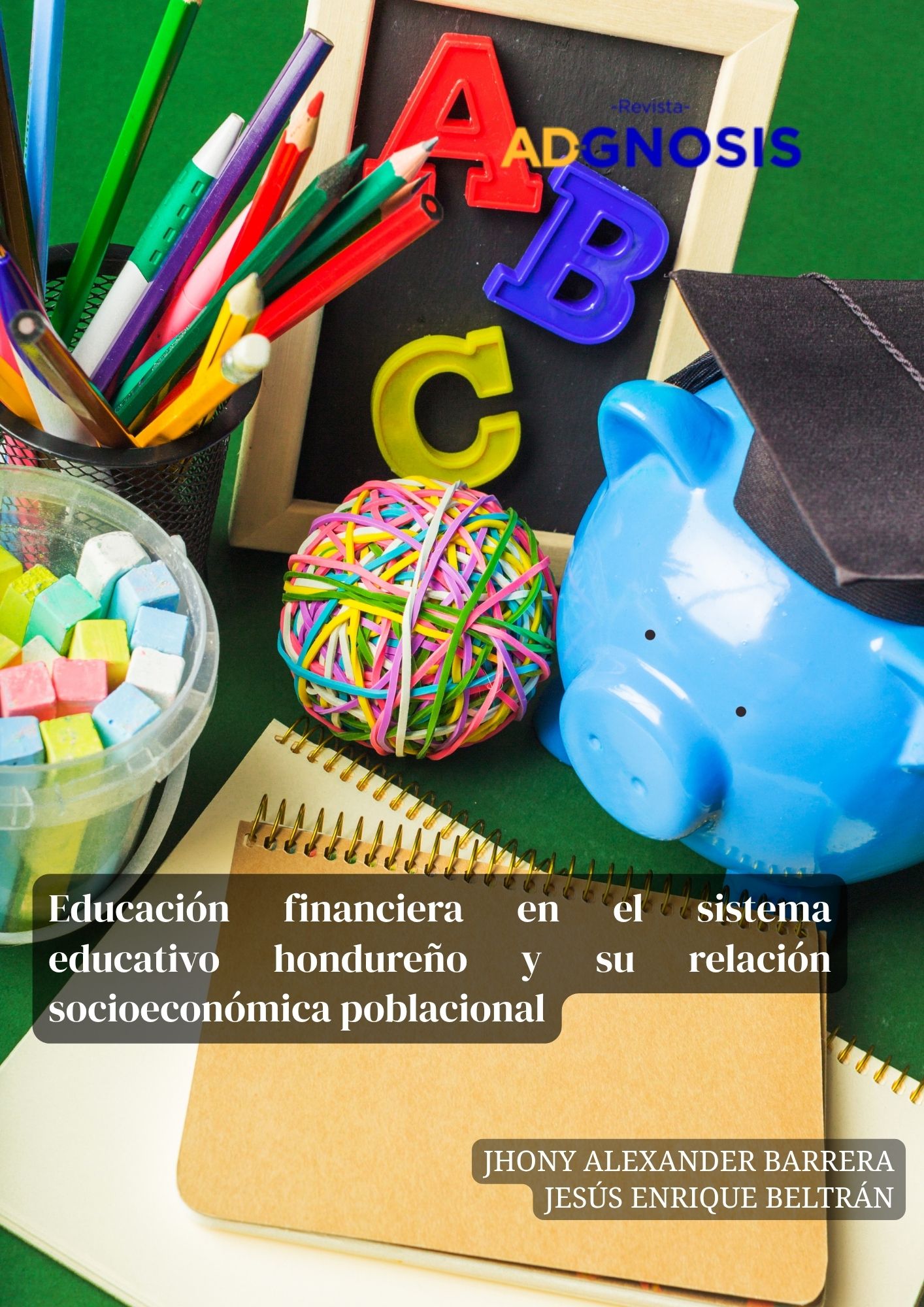
Strategies to Eradicate the Lack of Financial Education and Its Impact on Hondurans
DOI:
https://doi.org/10.21803/adgnosis.15.17.1048Keywords:
Financial Literacy, Human Capital, Capital , Financial Behavior, Financial Inclusion, Educational SystemAbstract
Introduction: In Honduras, there are significant challenges in properly managing personal finances, which limits families’ ability to plan their income and expenses and to make effective use of the products offered by financial institutions nationwide.
Objective: To design strategies that can be implemented in Honduras to improve financial education among the population and optimize household economic management.
Methodology: A mixed research approach was applied, integrating both quantitative and qualitative methods, with a correlational scope. The sample consisted of 246 individuals who were surveyed. The results revealed that 96% of respondents have a basic level of schooling corresponding to secondary education. Additionally, one of the main questions asked whether respondents agreed that including financial education in the school system would improve perceptions of its importance, and 93% affirmed this.
Conclusion: The study identified several key factors that limit financial education, starting with a general cultural issue and extending to educational barriers, highlighting the absence of financial education content in the national curriculum across different levels of education.
Downloads
References
Alvarez, H. (2024). Educación Financiera para la Ciudadanía: Desafíos y Perspectivas en el Contexto Chileno. Revista tecnológica educativa Docentes, 18–24. https://doi.org/10.37843/rted.v17i1.441
Arriaga, P., Ortega, m, Reynoso, G., Olivares, F., Juarez, E., Rodriguez, A., & Cruz, S. (2006). In ANÁLISIS CONCEPTUAL DEL APRENDIZAJE OBSERVACIONAL Y LA IMITACIÓN. Revista latinoamericana de psicologia (pp. 87–102). https://www.redalyc.org/pdf/805/80538106.pdf
Belen, L., Belén, M., Orazi, S., & Vigier, H. (2021). Instrumentos financieros clave para la inclusión financiera en Latino América. Revista Finanzas y Política Económica, 17–47. https://doi.org/10.14718/revfinanzpolitecon.v14.n1.2022.2
Fernández, A., Madrid, R. D., & Madrid, R. (2017). Las finanzas conductuales en la toma de decisiones. Scielo, 127–144.
FINDEX, G. L. O. B. A. L. (2024). Obtenido de. https://www.revistaeyn.com/finanzas/ranking-de-bancarizacion-de-los-paises-de-centroamerica-segun-el-informe-global-findex-OG26642185
Flores, J., & Silva, N. (2017). Unitec. Obtenido de. https://repositorio.unitec.edu/server/api/core/bitstreams/7cf3a15e-6709-4050-bdcc-f89cce89f744/content
Garcia, M., & Garcia, M. (2012). Los metodos de investigacion. Obtenido de. https://www.ucm.es/data/cont/media/www/pag-135806/12%20metodologc3ada-1-garcia-y-martinez.pdf
Garrido, C. (2007). LA EDUCACIÓN DESDE LA TEORÍA (pp. 73–80). DEL CAPITAL HUMANO Y EL OTRO. Scielo. https://ve.scielo.org/pdf/edu/v11n36/art10.pdf
Greenspan, A. (2025). Gale Ebooks. Obtenido de National Council for the Social Studies.
Hermosilla, J. L., & Hermosilla, J. F. (2016). Finanzas comportamentales: Una perspectiva interdisciplinaria dinámica. Obtenido de. https://repositorios.fca.unam.mx/alafec/docs/asambleas/xv/ponencias/6.02.pdf
Ibáñez, M. (2020, October 7). La educación financiera en Honduras—IEF. Instituto Estudios Financieros - Líder en conocimiento financiero. https://www.iefweb.org/ca/la-educacion-financiera-en-honduras/
Lopez, P. (2004). (P. O. B. L. A. C. I. Ó. N. M. U. E. S. T. R. A. Y. M. U. E. S. T. R. E. O. Scielo, Ed.; pp. 69–73). http://www.scielo.org.bo/scielo.php?script=sci_arttext&pid=S1815-02762004000100012
Moya, C., Flores, R., Aguilar, H., & Caicedo, J. (2025). Influencia de factores socioeconómicos en la inclusión financiera de hogares peruanos. Scielo, 1–8.
O.D.H. (2025). Obtenido de. https://odh.sedh.gob.hn/category/view/254/choluteca
O.E.C.D./C.A.F./E.C.L.A.C. (2018). Obtenido de. https://doi.org/10.1787/leo-2018-es
Ortega, R. M. M., Pendás, L. C. T., Ortega, M. M., Abreu, A. P., & Cánovas, A. M. (2009). El Coeficiente De Correlacion De Los Rangos De Spearman Caracterizacion. Revista Habanera de Ciencias Médicas, 8(2). https://www.redalyc.org/articulo.oa?id=180414044017
Padilla, A., & Sanchis, J. (2021). La relación causa-efecto entre exclusión/inclusión social y financiera. Una aproximación teórica. Revesco, 1–22. https://doi.org/10.5209/REVE.69168
Pérez, D., & Castillo, J. (2016). Capital humano, teorías y métodos: Importancia de la variable salud. Scielo, 651–673.
Plata, K., & Caballero, J. (2020). Influencia de los programas de educación financiera sobre el comportamiento de los jóvenes. https://dialnet.unirioja.es/servlet/articulo?codigo=9832069
Quintero, W. (2020). La formación en la teoría del capital humano: Una crítica sobre el problema de agregación. Scielo, 239–265.
Raccanello, K., & Herrera, E. (2014). Educación e inclusión financiera. Revista Latinoamericana de Estudios Educativos. https://www.redalyc.org/articulo.oa?id=27031268005
Ramírez, M. H. (2009). Finanzas Conductuales. Obtenido de. https://dialnet.unirioja.es/servlet/articulo?codigo=3202463
Rosenfeld, J. (2022). Yahoo Finance. Obtenido de. https://finance.yahoo.com/news/financial-literacy-around-world-top-120017481.html?N. E. S. (2009). (pp. 1–17). https://www.redalyc.org/pdf/7322/732280183007.pdf
Torres, N. (2015). El concepto de capital humano enfocado al conocimiento. Dialnet. Obtenido de. https://dialnet.unirioja.es/servlet/articulo?codigo=9163467
Trejos-Salazar, D. F., Osorio-Correa, S. L., Corrales-Marín, L. V., & Duque, P. (2021). Toma de decisiones financieras: Perspectivas de investigación. Revista de Ingenierías Interfaces, 22. https://dialnet.unirioja.es/descarga/articulo/8661426.pdf
Urdaneta, A., Solano, J., & Prieto, R. (2024). Análisis integral de categorías teóricas en la inclusión financiera: Una revisión sistemática. Revista Venezolanda de Gerencia. https://dialnet.unirioja.es/servlet/articulo?codigo=9948313
Vásquez, T., Gonzales, S., & Jolay, J. (2025). El aprendizaje vivencial y el desarrollo de habilidades sociales en la educación: Una revisión sistemática de los últimos cinco años. Scielo, 1–9.
Villanueva, A., Riveros, L., & Camacho, C. (2025). Comunidades de aprendizaje en el contexto educativo: Un artículo de revisión sistemática. Scielo, 1–9.
Virla, M. Q. (2010). Confiabilidad y coeficiente Alpha de Cronbach. https://www.redalyc.org/pdf/993/99315569010.pdf
Downloads
Published
Issue
Section
License
Copyright (c) 2026 AD-GNOSIS

This work is licensed under a Creative Commons Attribution-NonCommercial-NoDerivatives 4.0 International License.