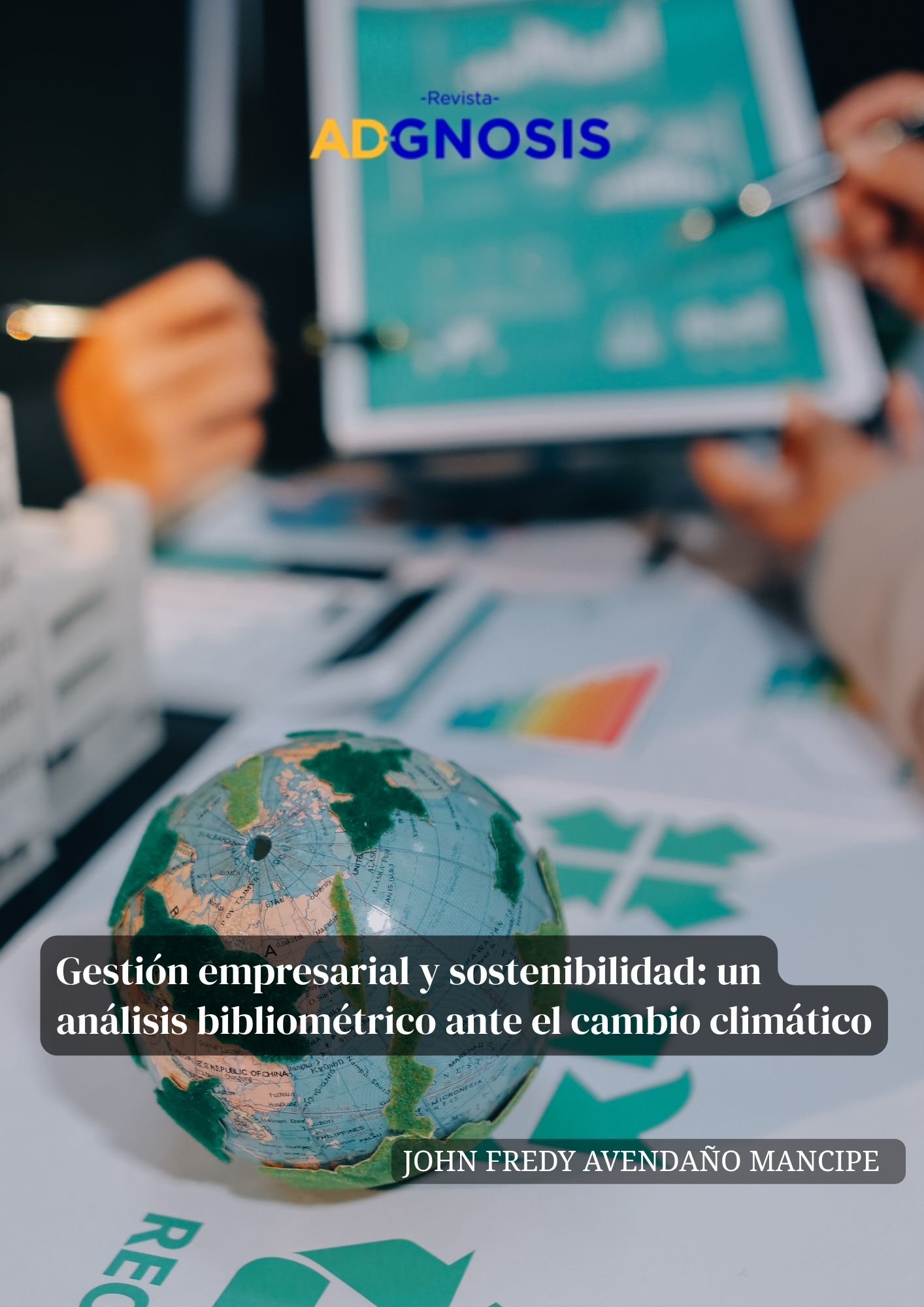
Business management and sustainability: a bibliometric analysis in the face of climate change
DOI:
https://doi.org/10.21803/adgnosis.15.17.953Keywords:
Study,, Bibliometric, Co-occurrence,, Business Management, Sustainable Development, Sustainable Renewable Energy, Climate ChangeAbstract
Objective: This article conducts a comprehensive bibliometric analysis of business management, sustainable development, clean technologies, and climate change. The study uses Elsevier’s Scopus database as its primary source, conducting a quantitative analysis of scientific output to identify publi-
cation patterns, prominent authors, and the most influential journals, among which Problemas del Desarrollo, Cuadernos de Economía, and the Revista Científica General José María Córdova stand out. Methodology: Statistical techniques for scientific mapping and data visualization were employed using VOSviewer software, enabling the construction of co-occurrence networks and density maps. Results: reveal exponential growth in academic productivity over the last few decades, with a strong presence of collaborative networks in Mexico, Colombia, Spai, and England. The cluster analysis shows a strong association between critical terms such as “Sustainable Development Goals (SDGs),” “Circular Economy,” “Environmental Accounting,” and “Business Management.” Conclusions: Current research is shifting from a purely operational perspective toward a strategic integration
of sustainability, in which renewable technologies, climate change adaptation and mitigation, and sustainable resilience are emerging as fundamental pillars of competitiveness and corporate governance in the 21st century.
Downloads
References
BBVA, (s.f.), ¿Qué es el desarrollo sostenible? Del concepto a los objetivos, Recuperado de https://www.bbva.com/es/sostenibilidad/que-es-el-desarrollo-sostenible-del-concepto-a-los-objetivos/
Camps, D. (2007). Estudio bibliométrico general de colaboración y consumo de la información en artículos originales de la revista Universitas Médica, período 2002 a 2006. Universitas Médica, 48(4), 358-365.
Carroll, A. B. (1991). The pyramid of corporate social responsibility: Toward the moral management of organizational stakeholders. Business Horizons, 34(4), 39-48.
ESNECA, (2019). Qué es y para qué sirve la gestión empresarial, Recuperado de https://www.esneca.com/blog/gestion-empresarial-que-es/
Gil Aluja (1997): “Nuevas técnicas de gestión de empresas” en Retos empresariales para 1998. Ed. Estola Universitaria d'Estudis Empresariales (U.B.). Barcelona, pág. 291.
Glänzel (2003). Bibliometrics as a research field. A course on theory and application of bibliometric indicators. Course handouts.
International Energy Agency (IEA). (2023). Renewable Energy Market Update. Recuperado de https://www.iea.org/reports/renewable-energy-market-update-june-2023
Intergovernmental Panel on Climate Change (IPCC). (2023). Climate Change 2023: Synthesis Report. Contribution of Working Groups I, II and III to the Sixth Assessment Report of the Intergovernmental Panel on Climate Change. IPCC. Recuperado de https://www.ipcc.ch/report/ar6/syr/
International Renewable Energy Agency (IRENA). (2020). Innovation Landscape for a Renewable-Powered Future: Solutions to integrate variable renewables. Recuperado de https://www.irena.org/media/Files/IRENA/Agency/Publication/2020/Apr/IRENA_Innovation_Landscape_2020.pdf
Naciones Unidas (s.f.), ¿Qué son las energías renovables?, Recuperado de https://www.un.org/es/climatechange/what-is-renewable-energy
Naciones Unidas (s.f.), ¿Qué es el cambio climático?, Recuperado de https://www.un.org/es/climatechange/what-is-climate-change
Porter, M. E., & Van Der Linde, C. (1995). Green and competitive: Ending the stalemate. Harvard Business Review, 73(5), 120-134.
Statista (2024), Emisiones mundiales de CO2 de 1995 a 2023, Recuperado de https://es.statista.com/estadisticas/635894/emisiones-mundiales-de-dioxido-de-carbono
Solano, Castellanos, López y Hernández (2009), La bibliometría: una herramienta eficaz para evaluar la actividad científica postgraduada, Revista Electrónica de las Ciencias Médicas en Cienfuegos, Medisur, Recuperado de: http://scielo.sld.cu/pdf/ms/v7n4/v7n4a745.pdf
United Nations. (2015). Transforming our world: The 2030 Agenda for Sustainable Development. Recuperado de https://sustainabledevelopment.un.org/post2015/transformingourworld
UN-Habitat. (2020). The New Urban Agenda. Recuperado de https://unhabitat.org/about-us/new-urban-agenda
United Nations. (2015). Transforming our world: The 2030 Agenda for Sustainable Development. Recuperado de https://sustainabledevelopment.un.org/post2015/transformingourworld
United Nations Environment Programme (UNEP). (2021). Adaptation Gap Report 2021: The Gathering Storm. Recuperado de https://www.unep.org/resources/adaptation-gap-report-2021
World Commission on Environment and Development. (1987). Our Common Future. Oxford University Press.
Downloads
Published
Issue
Section
License
Copyright (c) 2026 AD-GNOSIS

This work is licensed under a Creative Commons Attribution-NonCommercial-NoDerivatives 4.0 International License.