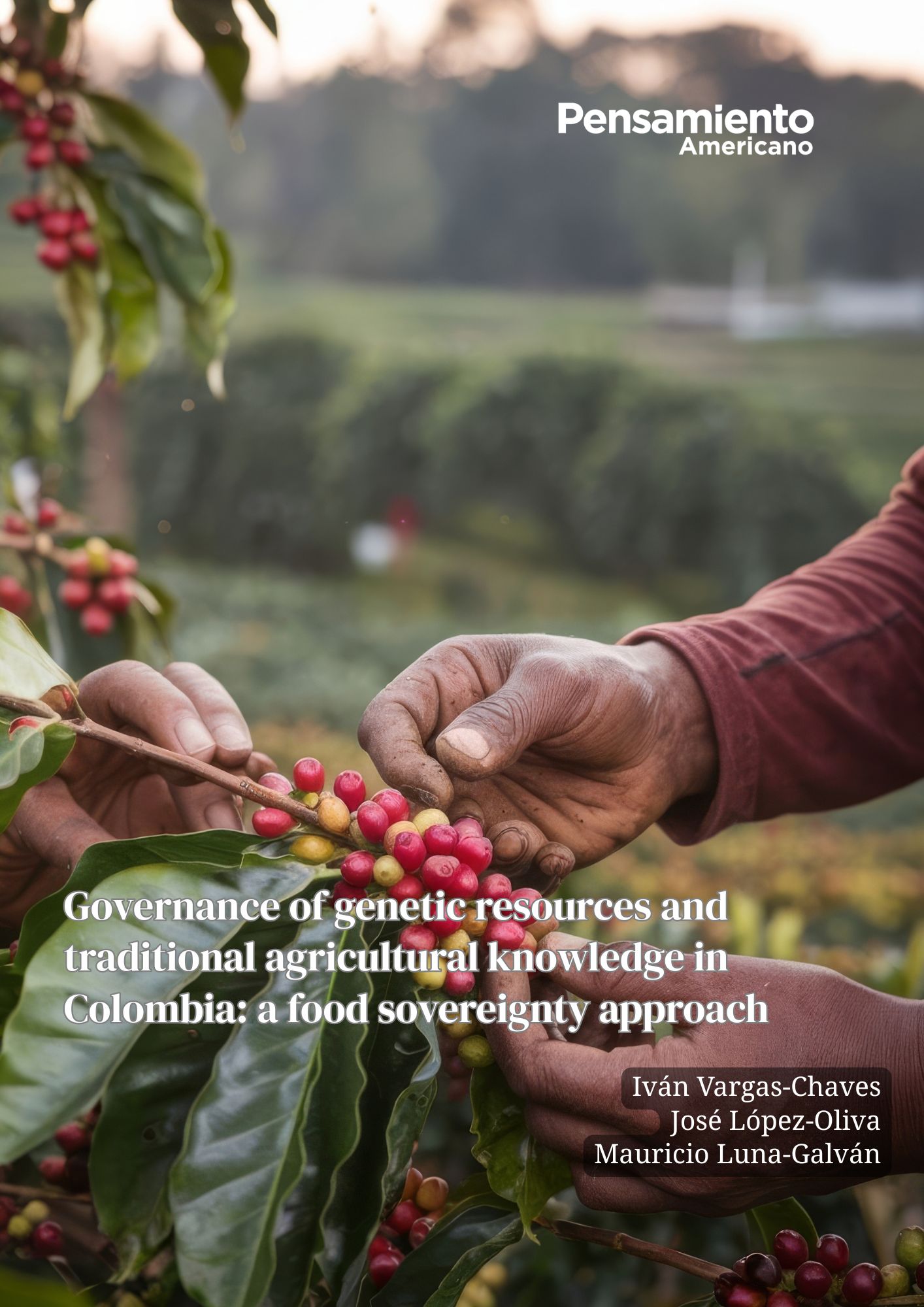
Governance of Genetic Resources and Traditional Agricultural Knowledge in Colombia: A Food Sovereignty Approach
DOI:
https://doi.org/10.21803/penamer.19.39.1010Keywords:
Food Sovereignty, Ecology of Knowledge, Environmental Governance, ; Genetic Resources, Traditional KnowledgeAbstract
Introduction: Although food sovereignty depends largely on control of agrobiodiversity and traditional knowledge, Colombia faces significant threats, such as biodiversity loss, dependence on commercial seeds, and unregulated bioprospecting. Objective: This article analyzes the relationship between genetic resource governance and food sovereignty in Colombia. Methodology: Through qualitative documentary analysis, this research evaluates how current agricultural policies and regulatory frameworks impact genetic diversity and the country’s ability to achieve autonomous food security. Results: The results reveal that traditional knowledge systems are fundamental to local adaptation, in situ conservation, and community empowerment; therefore, their erosion and biopiracy directly threaten these fundamental pillars. Conclusions: The analysis demonstrates that a governance model that prioritizes sustainable use and local control of genetic resources, together with the recognition of farmers’ rights, is essential to strengthening food sovereignty. Ultimately, the article advocates for legal reforms that integrate an “ecology of knowledge,” fostering dialogue between scientific and traditional systems to build resilient food systems for all Colombians.
Downloads
References
Acosta, O., & Chaparro-Giraldo, A. (2009). Biofuels, food security and transgenic crops. Revista de Salud Pública, 11(2), 290-300. https://doi.org/10.1590/S0124-00642009000200013
Action Group on Erosion, Technology and Concentration. (2007). Monsanto's Takeover of D&PL: The Nail's in the Coffin. ETC Group. https://www.etcgroup.org/content/monsantos-takeover-dpl-nails-coffin
Aguilera, M. (2013). Montes de María: A sub-region of peasant and business economy. Documentos de Trabajo Sobre Economía Regional y Urbana, No. 195. Banco de la República. https://www.banrep.gov.co/sites/default/files/publicaciones/archivos/dtser_195.pdf
Altieri, M. A. (2010). I. Why peasant agriculture? Agroecology, social and political movements in favor of food sovereignty. In J. Gascón, & X. Montagut (Eds.), A change of course in Latin American agrarian policies? (pp. 27-42). Icaria.
Altieri, M. A., & Toledo V. M. (2011). The agroecological revolution in Latin America: Rescuing nature, ensuring food sovereignty, and empowering peasants. Journal of Peasant Studies, 38(3), 587–612. https://doi.org/10.1080/03066150.2011.582947
Álvarez-Salas, L., & Gálvez-Abadía, A. (2014). Food Sovereignty in a Socioecological Transformation Context in the Caribbean Darién of Colombia. Agroecology and Sustainable Food Systems, 38(7), 812–838. https://doi.org/10.1080/21683565.2014.881951
Alzate-Mora, D., Rodríguez, G. A., & Vargas-Chaves, I. (2018). Access to justice and environmental participation. In G.A. Rodríguez (Ed.), Environmental justice in Colombia: Participatory exercise through constitutional actions (pp. 27-60). Grupo Editorial Ibáñez.
Ávila, Á. J., & Carvajal, Y. (2018). Agribusiness and food sovereignty in Colombia. Cuadernos de Geografía: Revista Colombiana de Geografía, 24(1), 43-60. https://doi.org/10.15446/rcdg.v24n1.37699
Benítez, P., & Miranda, L. (2013). Surface water contamination by pesticide residues in Venezuela and other Latin American countries. Revista Internacional de Contaminación Ambiental, 29(1), 7-23.
Berkes, F., Colding, J., & Folke, C. (2000). Rediscovery of traditional ecological knowledge as adaptive management. Ecological Applications, 10(5), 1251-1262. https://doi.org/10.1890/1051-0761(2000)010[1251:ROTEKA]2.0.CO;2
Bernstein, H. (2016). Agrarian political economy and modern world capitalism: the contributions of food regime analysis. The Journal of Peasant Studies, 43(3), 611-647. https://doi.org/10.1080/03066150.2015.1101456
Borras, S., & Franco, F. (2010). Towards a Broader View of the Politics of Global Land Grab: Rethinking Land Issues, Reframing Resistance. ICAS Working Paper Series, 1, 1-39.
Borras, S., McMichael, P., & Scoones, I. (2010). The politics of biofuels, land, and agrarian change. The Journal of Peasant Studies, 37(4), 575-592. https://doi.org/10.1080/03066150.2010.512448
Boyer, J. (2010) Food security, food sovereignty, and local challenges for transnational agrarian movements: the Honduras case. The Journal of Peasant Studies, 37(2), 319-351. https://doi.org/10.1080/03066151003594997
Castellanos-Navarrete, A., de Castro, F., & Pacheco, P. (2021). The impact of oil palm on rural livelihoods and tropical forest landscapes in Latin America. Journal of Rural Studies, 81, 294-304. https://doi.org/10.1016/j.jrurstud.2020.10.047
Ceccon, E. (2008). La revolución verde: tragedia en dos actos. Ciencias, 91, 21-29.
Chilon, E. (2017) Agricultura de la revolución verde y los suelos, aportes y controversias. Apthapi, 3(3), 844-859.
Clavijo Ponce, N. L., Combariza, J., & Barón, M. T. (2011). Reconocimiento del patrimonio territorial rural: caracterización de sistemas de producción de tubérculos andinos en Boyacá. Agronomía Colombiana, 29(2), 315-322.
Political Constitution of Colombia [Const.]. July 7, 1991 (Colombia).
Corts, E. (2024). Peasant Food Sovereignty in Guasca: Caught Between Plantations and Rural Gentrification. Rural Landscapes: Society, Environment, History, 11(1), 4. https://doi.org/10.16993/rl.98
Creswell, J. W., & Poth, C. N. (2018). Qualitative inquiry and research design: Choosing among five approaches (4th ed.). Sage publications.
Cruz, C., Dussán, C, Gaitán, J. y Callejas, W. (2018). Reflexiones sobre la problemática de la tenencia de la tierra y la seguridad alimentaria en Colombia. Universidad Cooperativa de Colombia. https://doi.org/10.16925/greylit.2469
Declaration of Nyéléni. (2007). Forum for Food Sovereignty. Nyéléni Village, Sélingué, Mali.
Del Castillo Matamoros, S., & Ramírez Noy, I. A. (2017). Análisis de la gobernanza, el territorio y la soberanía alimentaria en Colombia. Universidad Nacional de Colombia.
Díaz Avendaño, J. E., & Pachón Ariza, F. A. (2024). Peasant territoriality and food sovereignty: a case study in the Colombian massif. Revista de Economia e Sociologia Rural, 62(4), e277263. https://doi.org/10.1590/1806-9479.2022.277263
Domínguez, D. (2015). La soberanía alimentaria como enfoque crítico y orientación alternativa del sistema agroalimentario global. Pensamiento Americano, 8(15), 146-165. https://doi.org/10.21803/pensam.v8i15.85
Edelman, M. (2014). Food sovereignty: Forgotten genealogies and future regulatory challenges. Journal of Peasant Studies, 41(6), 959-978. https://doi.org/10.1080/03066150.2013.876998
Escobar, A. (2014). Sentipensar con la tierra: nuevas lecturas sobre desarrollo, territorio y diferencia. Ediciones Unaula.
Fajardo, D. A. (2018). Agricultura, campesinos y alimentos (1980-2010). Universidad Externado de Colombia.
Fernandes, B. M. (2017). Territorio y soberanía alimentaria. Revista Latinoamericana de Estudios Rurales, 2(3), 22-38.
Giraldo, O. F. (2015). Agroextractivismo y acaparamiento de tierras en América Latina: una lectura desde la ecología política. Revista mexicana de sociología, 77(4), 637-662.
Gómez Chaparro, C. J. (2013). Biocombustibles, desplazamiento forzado y seguridad alimentaria en Colombia [Undergraduate thesis, Universidad de los Andes]. Repositorio Institucional.
Gómez Lee, M. I. (2017). Biodiversidad y políticas públicas: coaliciones de causa en las políticas de acceso a los recursos genéticos en Colombia. Universidad Externado de Colombia.
Gómez Lee, M. I. (2023). El (des)orden en la gobernanza del acceso a los recursos genéticos y la participación en los beneficios. El rezago de Colombia frente a Ecuador y Perú. Universidad Externado de Colombia.
Gómez-Baggethun, E. (2009). Perspectivas del conocimiento ecológico local ante el proceso de globalización. Papeles de relaciones ecosociales y cambio global, 107, 57–67.
González, C. G. (2006). Genetically modified organisms and justice: the international environmental justice implications of biotechnology. Georgetown International Environmental Law Review, 19(4), 583-642.
González Torres, S., & Pachón Ariza, F. A. (2022). Peasant women and Food Sovereignty: proposals for a dignified life, the experience of Inzá, Cauca (Colombia). Revista de Economia e Sociologia Rural, 60(3), e248019. https://doi.org/10.1590/1806-9479.2021.248019
Gordillo, G. (2004). Seguridad alimentaria y comercio internacional. Revista de la CEPAL, 83, 71-84. https://repositorio.cepal.org/handle/11362/10969
Grupo Semillas. (2016). Resolución 3168 de 2015 del ICA sobre semillas reemplaza la Resolución 970. https://www.semillas.org.co/es/la-resoluci
Gutiérrez Escobar, L. (2019). Biocultural diversity, raizal agriculture and food sovereignty in San Andrés y Providencia (Colombia). Tabula Rasa, (32), 195–225. https://doi.org/10.25058/20112742.n32.09
Gutiérrez Escobar, L. (2017). Seed Sovereignty Struggles in an Ember-Cham Community in Colombia. Alternautas, 4(2), 27–45.
Gutiérrez Escobar, L. M. (2011). El proyecto de la soberanía alimentaria: construyendo otras economías para el buen vivir. Otra economía, 5(8), 59–72.
Gutiérrez Escobar, L. M. (2015). Soberanía alimentaria. La Red de Semillas Libres de Colombia. [Con]textos, 4(13), 11-24.
Harvey, D. (2007). A brief history of neoliberalism. Oxford University Press.
Harwood, J. (2009). Peasant friendly plant breeding and the early years of the green revolution in Mexico. Agricultural History, 83(3), 384-410. https://doi.org/10.3098/ah.2009.83.3.384
Holt-Giménez, E., & Altieri, M. A. (2013). Agroecología, soberanía alimentaria y la nueva Revolución Verde. Agroecología, 8(2), 65-72.
Howard, P. H. (2016). Corporate concentration in the global seed industry. The GECKO, Global Justice Ecology Project.
Jarosz, L. (2014). Comparing food security and food sovereignty discourses. Dialogues in Human Geography, 4(2), 168-181. https://doi.org/10.1177/2043820614537161
Karam, M.A., Ramírez, G., Bustamante-Montes, L.P., & Galván, J.G. (2004). Plaguicidas y salud de la población. Ciencia Ergo Sum, 11(3), 246-254.
Lander, E. (2010). The limits of the planet and Civilizational Crisis. Transnational Institute.
León, T. (2004). Transgénesis, agricultura y ambiente. Gestión y Ambiente, 7(1), 5–16.
León, X. (2014). Transgénicos, agronegocio y soberanía alimentaria. Letras verdes. Revista Latinoamericana de Estudios Socio Ambientales, 16, 29-53. https://doi.org/10.17141/letrasverdes.16.2014.1235
Mançano Fernandes, B. (2017). Territorios y soberanía alimentaria. Revista Latinoamericana de Estudios Rurales, 2(3), 1-19.
Margulis, M. E., & Porter, T. (2013). Governing the global land grab: Multipolarity, ideas, and complexity in transnational governance. Globalizations, 10(1), 65-86. https://doi.org/10.1080/14747731.2013.760930
Maxwell, S. (1996). Food security: a post-modern perspective. Food policy, 21(2), 155-170. https://doi.org/10.1016/0306-9192(95)00074-7
Maza, F. J., Herrera, G. A., & Jiménez, T. I. (2017). Palma de aceite y seguridad alimentaria en el Caribe colombiano: el caso del municipio de María La Baja, Bolívar. Revista Palobra, 17, 122-143. https://doi.org/10.32997/2346-2884-vol.17-num.17-2017-1828
McMichael, P. (2012). Development and Social Change: A Global Perspective (5th ed.). SAGE.
Micarelli, G. (2018). Soberanía alimentaria y otras soberanías: el valor de los bienes comunes. Revista Colombiana de Antropología, 54(2), 119-142. https://doi.org/10.22380/2539472X.464
Micarelli, G. (2020). Apertura ontológica y lucha anticolonial en la soberanía alimentaria: un diálogo con perspectivas indígenas de Abya Yala. e-cadernos CES, 34. https://doi.org/10.4000/eces.5645
Ojeda, D., Petzl, J., Quiroga, C., Rodríguez, A. C., & Rojas, J. G. (2015). Paisajes del despojo cotidiano: acaparamiento de tierra y agua en Montes de María, Colombia. Revista de Estudios Sociales, (54), 107-119. https://doi.org/10.7440/res54.2015.08
United Nations. (1948). Universal Declaration of Human Rights.
United Nations. (1966). International Covenant on Economic, Social and Cultural Rights.
United Nations. (2018). United Nations Declaration on the Rights of Peasants and Other People Working in Rural Areas.
Parraguez-Vergara, E., Contreras, B., Clavijo, N., Villegas, V., Paucar, N., & Ther, F. (2018). Does indigenous and campesino traditional agriculture have anything to contribute to food sovereignty in Latin America? Evidence from Chile, Peru, Ecuador, Colombia, Guatemala and Mexico. International Journal of Agricultural Sustainability, 16(6), 445-459. https://doi.org/10.1080/14735903.2018.1489361
Perelmuter, T. (2018). El cercamiento de las semillas y su construcción como bienes apropiables según el sistema de propiedad intelectual: algunas reflexiones sobre el caso argentino. SaberEs, 10(2), 107-127. https://doi.org/10.35305/s.v10i2.158
Ramírez, M. A., Nieto Gómez, L. E., & Giraldo Daz, R. (2019). Fundamento ético del derecho a la soberanía alimentaria en Colombia. Cuestiones constitucionales, (41), 475–495. https://doi.org/10.22201/iij.24484881e.2019.41.13940
Ramírez, N., & Tobón, G. (2013). Observatorio de Territorios Étnicos. https://etnoterritorios.org/es/centro-de-documentacion
Ramírez, Y. V., & Rojas, M. (2018). Análisis narrativo de la política pública: soberanía y seguridad alimentaria en Colombia (1991-2016). Universidad de La Salle.
Rey-Lema, D. M., & Peña-Galindo, A. (2024). Soberanía alimentaria: un análisis de la parcialidad indígena Cañamomo Lomaprieta, resistencias locales frente a la dominación. Via Inveniendi Et Iudicandi, 19(1), 10–24. https://doi.org/10.15332/19090528.9967
Reyes Benavides, H. A., & Sánchez Castillo, V. (2024). Diseño de una estrategia local para el fortalecimiento de la soberanía alimentaria: caso del predio municipal el Pedregal de Villagarzón Putumayo. Southern perspective / Perspectiva austral, 2, 25. https://doi.org/10.56294/pa202425
Rodríguez Sánchez, R. (2017). Ley 1776 de 2016 (Ley Zidres) Explotación económica de las Zidres a través de proyectos productivos no agropecuarios. ¿Una amenaza a la soberanía y seguridad alimentaria de Colombia? Universidad Católica de Colombia.
Rosset, P. M. (2003). Food sovereignty: global rally cry of social movements. Institute for Food and Development Policy.
Rosset, P., & Martínez, M. E. (2014). La soberanía alimentaria: un reclamo mundial del movimiento campesino. Ecofronteras, 18(50), 8-11.
Sarmiento, J. P. (2018). La reforma agraria pospuesta y la concentración de la tierra en Colombia. Revista de Derecho, (49), 1-31. https://doi.org/10.14482/dere.49.10200
Schanbacher, W. D. (2010). The politics of food: the global conflict between food security and food sovereignty. ABC-CLIO.
Shiva, V. (1997). Biopiracy: the plunder of nature and knowledge. South End Press.
Thorsen, D. E. (2009). The Neoliberal Challenge. Oslo University.
Torres Rivera, D. A., & Córdoba Cantero, R. (2022). Capacidad de resiliencia de los pequeños productores de arroz en Colombia y sus implicaciones para la Soberanía Alimentaria en el contexto de pandemia. Redes. Revista do Desenvolvimento Regional, 27. https://doi.org/10.17058/redes.v27i1.17946
Valencia Duarte, D. (2022). The Peasant Food Question: Agrarian Reforms, Depeasantisation and Food Sovereignty in Dispute, Colombia, 1961-2013. [Doctoral dissertation, International Institute of Social Studies]. Erasmus University Rotterdam.
Windfuhr, M., & Jonsén, J. (2005). Food sovereignty. Towards democracy in localized food systems. ITDG Publishing.
Wittman, H. (2011). Food sovereignty: A new rights framework for food and nature? Environment and Society, 2(1), 87-105. https://doi.org/10.3167/ares.2011.020106
Downloads
Published
Issue
Section
License
Copyright (c) 2026 Pensamiento Americano

This work is licensed under a Creative Commons Attribution-NonCommercial-NoDerivatives 4.0 International License.
The author or authors of an article accepted for publication in the Journal Pensamiento Americano will transfer all of the patrimonial rights to the American University Corporation free of charge, within which are included: the right to edit, publish, reproduce and distribute both print media as digital, in addition to include in article in international indexes and / or databases, likewise, the Editorial Seal is authorized to use the images, tables and / or any graphic material presented in the article for the design of covers or posters from the same magazine. By assuming the patrimonial rights of the article, it may not be partially or totally reproduced in any printed or digital media without its express permission.
AUTHORITY ASPECTS
For the Pensamiento Americano Journal, all the authors of an article have made substantial contributions to the research and the manuscript, and they share the responsibility when the article presents errors, fraud in some way or violations of copyright.
After submitting an article, the journal does not accept the addition, deletion or change in the order of the authors, in addition we reserve the right to release the article when it has been submitted to the journal and under no circumstances will American Thought accept the article. withdrawal of an article during any phase of the editorial process