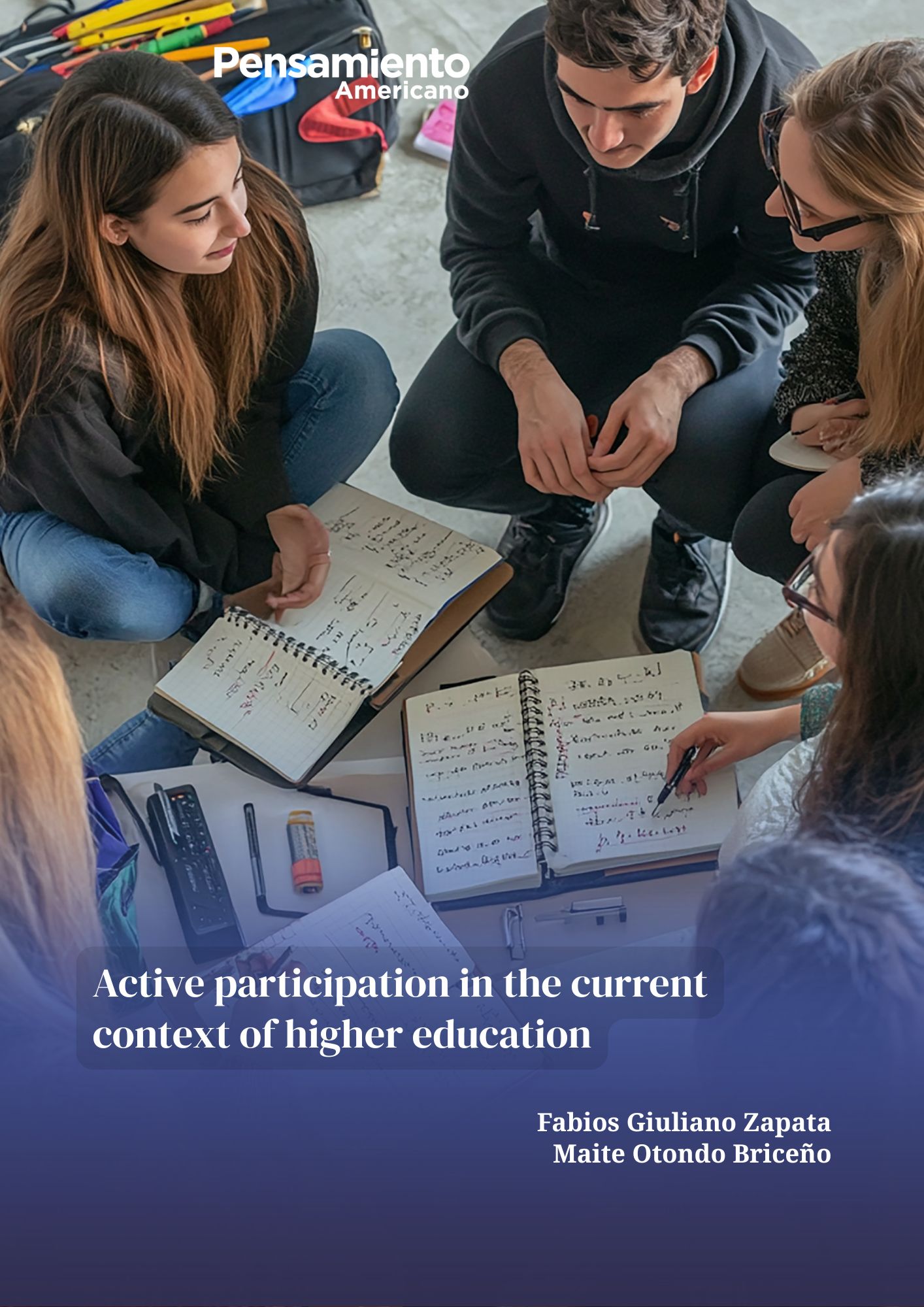
Active participation in the current context of higher education.
DOI:
https://doi.org/10.21803/penamer.19.39.941Keywords:
educational participation, education, active learning, studentsAbstract
Introduction: The problem addressed in this article refers to the insufficient level of active participation by students, which has been evident in the international context in the field of higher education. Objective: To place this issue in the Chilean national context, investigating the levels of active participation present in a sample of third-year students studying special education at the Catholic University of the Most Holy Conception. Methodology: To achieve the proposed goal, the “Class Participation Factors Questionnaire” was administered, and systematic observation and interviews with teachers were conducted. Results: The results revealed the presence of a mixed teaching methodology among teachers, as well as a lack of knowledge among students and a positive self-perception of participation. Conclusions: It was concluded that there is a need
to improve the factors linked to active participation, as the results obtained reveal areas
for improvement in this regard.
Downloads
References
AbebeAbera, T. EbrahimYimam, R. ShekaShemsi, S. (2020). Knowledge on active participation in classroom among nursing and midwifery students. Journal of Education and Learning, 14(3), 352-361. https://doi.org/10.11591/edulearn.v14i3.15645
Aldana, J. A., Mejía, G. A., & Ruiz Hernández, R. E. (2017). Estrategias que permitan mejorar la participación activa durante el proceso de aprendizaje en estudiantes de Formación Docente de la Escuela Normal José Martí de Matagalpa [Tesis de maestría, Universidad nacional autónoma de Nicaragua]. https://core.ac.uk/download/pdf/154177631.pdf
Alvarado Valera, E. Alvarado Valera, J. A. Guzmán Frías, C. Llamas Martínez, B. y Quezada Sánchez, A. C. G. (2024). Estrategias para fomentar la participación activa de los estudiantes en el aula universitaria. Revista Latinoamericana de ciencias sociales y humanidades, 5(3), 2179-2188. https://doi.org/10.56712/latam.v5i3.2187
Arbesú García, M. I. y Ramírez Elías A. (2019). El objeto de conocimiento en la investigación cualitativa: un asunto epistemológico. ENEO, 16(4), 424-435. https://doi.org/10.22201/eneo.23958421e.2019.4.735
Bueno de Moraes, E. M. Cecilio Fernandes, D. Dos Santos Carvalho, D.R. Martins Santos, T. Mirabetti Ozahata, T. Patel, R. Sandars, J. Unravelling the differences between observation and active participation in simulation-based education. Medical Teacher, 47(6), 991–996. https://doi.org/10.1080/0142159X.2024.2396381
Campos y Covarrubias, G. y Lule Martínez, N. (2012). La observación, un método para el estudio de la realidad. Xihmai, 7(13), 45-60. https://doi.org/10.37646/xihmai.v7i13.202
Fernández Navas, M. y Alcaraz Salarirche, N. (2016). Proyedu2: la participación y la democracia son posibles en la formación de docentes. Pirámide. 189-205. https://dialnet.unirioja.es/servlet/articulo?codigo=6073668
Flores-Fernández, C. y Durán Riquelme, A. (2022). Participación activa en clases Factores que intervienen en la interacción de los estudiantes en clases online sincrónicas. Información, cultura y sociedad, (46), 129-142. https://doi.org/10.34096/ics.i46.11069
Galván Cardoso, A. P. y Siado Ramos, E. (2021). Educación Tradicional: Un modelo de enseñanza centrado en el estudiante. CIENCIAMATRIA, 7(12), 962-975. https://doi.org/10.35381/cm.v7i12.457
Gozález Pardo, L. M. y Valderrama, D. A. (2024). Transmutando la Inercia Pedagógica: Aprendizaje Activo en la Enseñanza de la física. Opuntia Brava, 16(4), 87-100. https://www.researchgate.net/publication/385379958_Transmutando_la_Inercia_Pedagogica_Aprendizaje_Activo_en_la_Ensenanza_de_la_fisica
Greene, K. (2013). The Theory of Active Involvement: Processes Underlying Interventions that Engage Adolescents in Message Planning and/or Production. Health Communication, 28(7), 644-656. https://doi.org/10.1080/10410236.2012.762824
Herrera, C. (2016). Participación y aprendizaje en estudiantes universitarios instrumentos para un análisis inclusivo. Red universitaria de educación especial, 5(7), 39-77. https://bdigital.uncu.edu.ar/objetos_digitales/8396/herreraruedes7.pdf
Komatsuzaki, S. Peng, S. Sen, R. (2025). Temporal equal and active participation in synchronous collaborative learning: Antecedents and effect for learning. Plos one, 20(3), 1-25. https://doi.org/10.1371/journal.pone.0318122
Moliní Fernández, F. y Sánchez González, D. (2019). Fomentar la participación en clase de los estudiantes universitarios y evaluarla. REDU, 17(1), 211-227. https://doi.org/10.4995/redu.2019.10702
Ramos Galarza, C. (2020). Los alcances de una investigación. CienciAmérica, 9(3), 1-6. http://dx.doi.org/10.33210/ca.v9i3.336
Rueda Pineda, E., Mares Cárdenas, G., Gonzáles Beltrán, L., Rivas García, O., & Rocha Leyva, H. (2017). La participación en clase en alumnos universitarios: factores disposicionales y situacionales. Revista Iberoamericana de Educación, 74(1), 149-162. https://doi.org/10.35362/rie741632
Sáez López, J. (2017). Fundamentos teóricos, procesos y elementos prácticos. UNED. https://books.google.cl/books?id=c3CZDgAAQBAJ&printsec=frontcover&hl=es&source=gbs_ge_summary_r&cad=0#v=onepage&q&f=false
Swan, K. y Shih, L. (2005). On the nature development of social presence online course discussions. Journal of Asynchorinous Learning Networks, 9(3), 115-136. https://doi.org/10.24059/olj.v9i3.1788
Tatalović Vorkapić, S. y Tomljenović, Z. (2020). Constructivism in Visual Arts Classes. C·E·P·S Journal, 10(4), 13-32. https://doi.org/10.26529/cepsj.913
Téllez, M. N. B., Díaz, M. C. y Gómez, A. R. (2007). Piaget y L. S. Vigotsky en el análisis de la relación entre educación y desarrollo. Revista Iberoamericana de Educación, 43(1), 1–12. https://doi.org/10.35362/RIE4312341
Velazco Rolón, C. A. y Rolón Cuyuá, M. A. (2024). Factores que afectan la participación activa de los estudiantes en clases, del primer año de Ciencias de la Educación de la Universidad Nacional de Pilar 2024. Revista latinoamericana de ciencias sociales y humanidades, 5(5), 2573-2588. https://doi.org/10.56712/latam.v5i5.2799
Downloads
Published
Issue
Section
License
Copyright (c) 2026 Pensamiento Americano

This work is licensed under a Creative Commons Attribution-NonCommercial-NoDerivatives 4.0 International License.
The author or authors of an article accepted for publication in the Journal Pensamiento Americano will transfer all of the patrimonial rights to the American University Corporation free of charge, within which are included: the right to edit, publish, reproduce and distribute both print media as digital, in addition to include in article in international indexes and / or databases, likewise, the Editorial Seal is authorized to use the images, tables and / or any graphic material presented in the article for the design of covers or posters from the same magazine. By assuming the patrimonial rights of the article, it may not be partially or totally reproduced in any printed or digital media without its express permission.
AUTHORITY ASPECTS
For the Pensamiento Americano Journal, all the authors of an article have made substantial contributions to the research and the manuscript, and they share the responsibility when the article presents errors, fraud in some way or violations of copyright.
After submitting an article, the journal does not accept the addition, deletion or change in the order of the authors, in addition we reserve the right to release the article when it has been submitted to the journal and under no circumstances will American Thought accept the article. withdrawal of an article during any phase of the editorial process