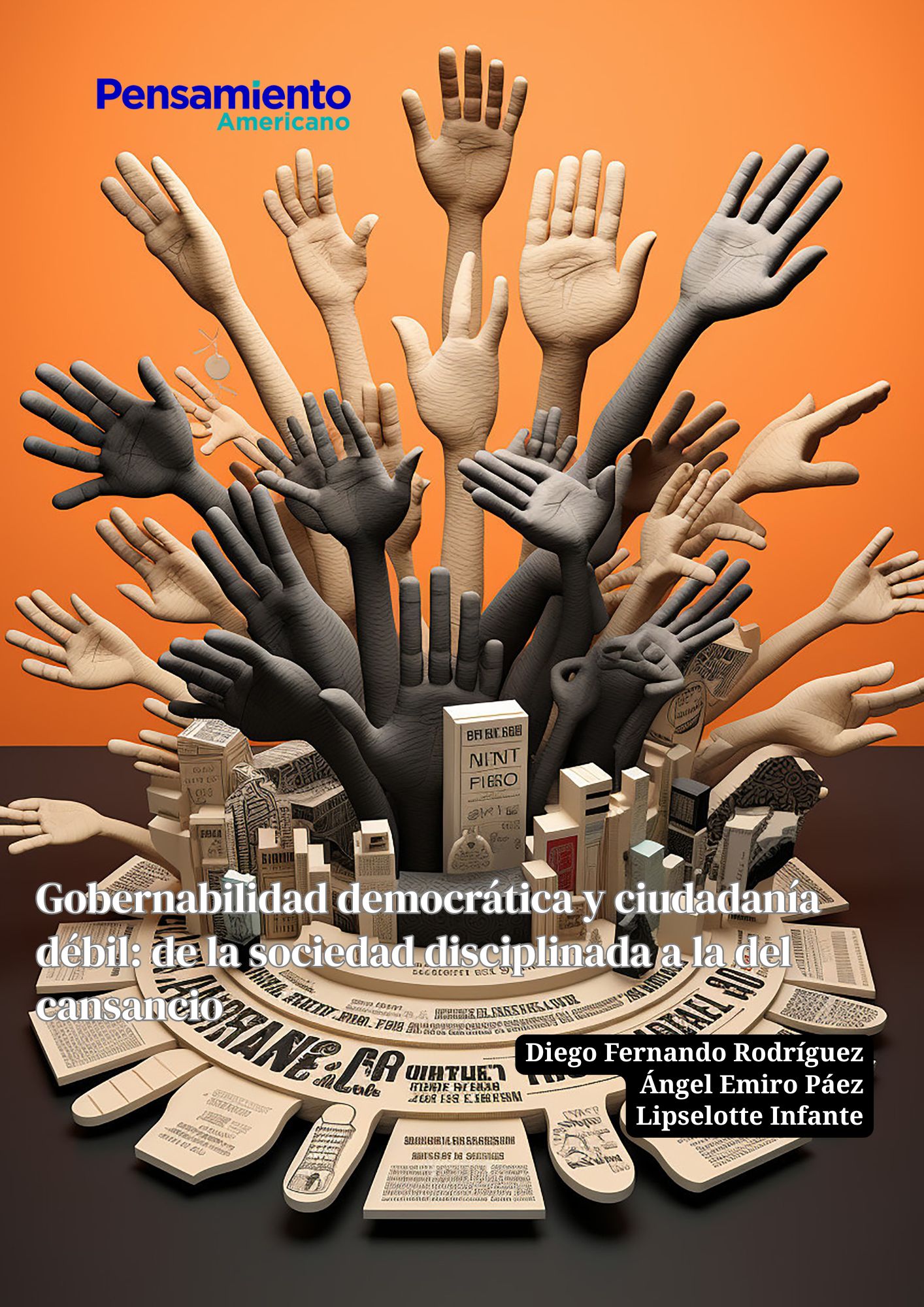
Democratic governance and weak citizenship: from a disciplined society to one of exhaustion
DOI:
https://doi.org/10.21803/penamer.19.40.1073Keywords:
disciplined society, performance society, psychological violence, democratic governanceAbstract
- i) Introduction: This paper explains how the disciplined society described by Foucault, based on the modal verb “you must”, has given way to the performative society described by Byang Chul Han, based on the modal verb “you can” It examines the architectural devices through which power was controlled and exercised over bodies, which were arranged according to their functions. ii) Objective: To explain the transition from the disciplined society to the performance/exhaustion society and its effects on the generation of weak citizenship and a crisis of democratic governance. iii) Methodology: A qualitative-critical approach was used, with a theoretical-conceptual scope. A selective literature review of theoretical sources and a descriptive pilot survey were conducted. The analysis employed hermeneutic-interpretive analysis of philosophical texts and basic descriptive-statistical analysis of the survey data. iv) Results: It is demonstrated that the performance-driven individual, distracted by individualism and self-imposed demands, generates weak citizenship and a crisis of democratic governance due to a lack of social capital and civic culture; v) Conclusions: The performance-driven individual is distracted by individualism, fulfilling self-imposed demands and distancing themselves from political activities, generating weak citizenship and a crisis of democratic governance due to the lack of social capital for the development of the civic culture of a democratic system.
Downloads
References
Almond, G., Dahl, R., & Mosca, G. (2001). Diez Textos Básicos de Ciencia Política. Barcelona: Ariel.
Alsina, M. R., & Cerqueira, L. (2019). Periodismo, ética y posverdad. Cuadernos.info, 225-239.
Althusser, L. (1976). Ideología y aparatos ideológicos del Estado. Buenos Aires: Nueva Visión.
Álvarez Collazos, A. (2009). La historia del sistéma de mérito y la aplicación de la carrera administrativa en Colombia. Bogota: Escuela Superior de Administración Pública .
Asimakopoulos, G., Antonopoulou, H., Giotopoulos, K., & Halkiopoulos, C. (2025). Impact of Information and Communication Technologies on Democratic Processes and Citizen Participation. Societies. https://doi.org/10.3390/soc15020040
Avaro, D. (Mexico). La posverdad. Una guía introductoria. Andamios vol.18 no.46.
Bautista, O. D. (2006). La ética y la corrupción en la política y la administración pública. Andalucia : Universidad Internacional de Andalucía.
Borja, A., Torneo, A., & Hecita, I. (2024). Challenges to Democratization from the Perspective of Political Inaction: Insights into Political Disempowerment and Citizenship in the Philippines. Journal of Current Southeast Asian Affairs, 44, 3 - 29. https://doi.org/10.1177/18681034241239060
Bourdieu, P. (2000). Poder, derecho y clases sociales. Bilbao: Desclée de Brouwer S.A. .
Burton, S., & Bowman, B. (2022). The academic precariat: understanding life and labour in the neoliberal academy. British Journal of Sociology of Education, 43, 497 - 512. https://doi.org/10.1080/01425692.2022.2076387
Byun-Chul, H. (2014). La Psicopolítica. Barcelona : Heder.
Byung- Chul, H. (2016). La topologia de la violencia. Barcelona: Heder.
Byung-Chul , H. (2012). La agonía del Eros. Barcelona: Herder.
Byung-Chul, H. (2016). La sociedad del cansancio. Berlín: Herder.
Camargo-Vega, J. J., Camargo Ortega, J. F., & Joyanes Aguilar, L. (2015). Conociendo Big Data. Revista Facultad de Ingeniería.
Clavijo-López, R., Cruz-Tarrillo, J., Ancajima, R., Escobedo, F., Saldaña, C., Barrante, J., Gonzales, T., & Tananta, C. (2025). Democracy and Citizen Participation: A Comparative Study Between Peru and Ecuador. Academic Journal of Interdisciplinary Studies. https://doi.org/10.36941/ajis-2025-0045
D’Adamo, O., Beaudoux, V. G., & Kievsky, T. (2015). Comunicación política y redes sociales: análisis de las campañas para las elecciones legislativas de 2013 en la ciudad de Buenos Aires. Revista mexicana de opinión pública.
D’Cruz, L. (2024). The normative stakes of Foucault's engagement with neoliberalism: Seduction, invention, and normalization. The Southern Journal of Philosophy. https://doi.org/10.1111/sjp.12589
Deutsch, K. w. (1976). Política y gobierno. Mexico : Fondo de Cultura Económica.
Dobbernack, J. (2025). Why Neoliberalism Doesn't Spell the Death of Society: Commonality, Regulation, and the Politics of Social Cohesion.. The British journal of sociology. https://doi.org/10.1111/1468-4446.70031
Duverger, M. (1970). Instituciones Politicas y Derecho Constitucional . España: Aries, S.A.
Ferré Pavia, C. (2014). El uso de las redes sociales: ciudadanía, política y comunicación. La investigación en España y Brasil . Barcelona : INCOM Universidad Autónoma de Barcelona .
Foucault, M. (1976). Vigilar y Castigar. Paris: Gallimard.
Foucault, M. (1978). “Microfísica del Poder”. Obtenido de http://www.medicinayarte.com/img/biblioteca_virtual_publica_foucault_microfisicadelpoder.pdf
Fromm, E. (1941). El Miedo a la Libertad. Buenos Aires: Pailos.
Gäckle, N. (2023). Governing pandemic fatigue: an International Relations case of experiential biopolitics. European Journal of International Relations. https://doi.org/10.1177/13540661231183357
Garay Salamanca, L. J., & Salcedo Albarán, E. (2018). El Gran Libro de la Corrupción en Colombia. Bogota: Planeta.
García Jurado, R. (2006). La impotencia del poder político . Mexico : Red Política y Cultura.
Guzmán Mendoz, C. E. (2008). La política como objeto de reflexión. Revista de Derecho.
Hannah, A. (1997). ¿Qué es la política? Barcelona: Paidós.
Harrebye, S., Ejrnæs, A., & Ørsten, M. (2025). The Sole Effect of Double Standards—How Public Scandalization of Political Hypocrisy Influences Citizens' Democratic Trust and Engagement. Scandinavian Political Studies. https://doi.org/10.1111/1467-9477.70026
Hernández Quintana, A. R. (2017). Resilencia de la organización de la información en la era de la. Revista Cubana de información y comunicación, 47-59.
Jiménez Ruíz , F. J. (2005). Financiamiento a partidos políticos y teoría de juegos. México: Miguel Ángel Porrúa.
King, M., & Wilson, R. (2022). Local government and democratic innovations: reflections on the case of citizen assemblies on climate change. Public Money & Management, 43, 73 - 76. https://doi.org/10.1080/09540962.2022.2033462
Kiss, B., Sekulova, F., Hörschelmann, K., Salk, C., Takahashi, W., & Wamsler, C. (2022). Citizen participation in the governance of nature‐based solutions. Environmental Policy and Governance. https://doi.org/10.1002/eet.1987
Kutay, A. (2023). From Social Sphere to Intermediary Association: A Critical Analysis of Civil Society’s Neoliberal Transformation. Critical Sociology, 50, 31 - 47. https://doi.org/10.1177/08969205231180263
Lipovetsky, G. (2006). El imperio de lo efímero. Barcelona: Anagrama .
López, E. (2016). Byung-Chul Han. La sociedad de la transparencia. Revista mexicana de sociología, 153-164.
Martínez-Ferro, H. (2010). Legitimidad, dominación y derecho en la teoría sociológica del estado de Max Weber. Estudios Socio-Jurídicos, 405-427.
Merton , R. K. (1976). Teoría y estructura sociales. Mexico: Fondo de Cultura Económica.
Molina Giraldo, J. M. (2004). Reconstruccion de la racionalidad pública de la administración estatal. Bogota: Escuela Superior de Administración Pública .
Montero Bagatella, J. C. (2012). Gobernabilidad: Validez/Invalidez o moda del concepto. Revista mexicana de ciencias políticas y sociales.
Neira , H. (2014). Política y vida animal: la analogía del buen gobierno. Scientae Studia Artigos.
Pacheco-Jaramillo, W., & Malliaros, P. (2025). Income Inequality, Governance Quality, and Political Engagement: A Cross-country Analysis of Disparities and Democratic Participation. F1000Research. https://doi.org/10.12688/f1000research.164654.1
Pérez Martínez, A. (2009). Cultura organizacional: algunas reflexiones a la luz de los nuevos retos. Revista Venezolana de Gerencia v.14 n.46 Maracaibo jun. , 183-194.
Pérez Salazar, B. (2003). Guerra y Terrorismo en Colombia. Sociologia Jurídica. Homenaje a Fernando Hinestrosa 40 años de Rectoría 1963-2003. Bogota: Externado de Colombia.
Posadas Velázque, R. (2013). La vida de consumo o la vida social que se consume: apreciaciones sobre la tipología ideal del consumismo de Zygmunt Bauman. Estudios políticos, 115-127.
Quintero Camarena, G. (2017). La sociedad del cansancio, Byung-Chul Han. Culturales, año I, número 2, julio-diciembre de 2017, 321-328.
Ramos García, J. M. ( 2016). Gestión por resultados en México, 2013-2014. Algunos impactos en Baja California. Estudios fronterizos, 64-88.
Rocca Vásquez, A. (2008). Zygmunt Bauman: modernidad líquida y fragilidad humana. Revista Crítica de Ciencias Socailes y Jurídicas. Universidad Complutense de Madrid., 19.
Rodriguez Casallas, D. F. (2017). Caso plebiscito de refrendación de los acuerdos de paz FARC-EP y gobierno colombiano: redes sociales, ética pública y construcción de la opinión pública. XXII Congreso Internacional del CLAD sobre la Reforma del Estado y de la Administración Pública, 14-17.
Rodriguez Casallas, D. F. (2017). Despolitización y ética pública en la modernidad líquida. La crisis del pensarse en colectivo en la modernidad líquida. Justicia, 65-86.
Rodriguez Casallas, D. F. (2020). Paros, crisis institucional en américa latina y gobernanza. Justicia, 151-166.
Roth Deubel, A. N. (2012). Políticas Públicas. Bogota : Aurora.
Rúa Delgado, Carlos. (2013). La legitimidad en el ejercicio del poder político en el estado social de derecho una revisión desde el caso colombiano. Ius et Praxis vol.19 no.2 Talca 2013, 85-122. doi:http://dx.doi.org/10.4067/S0718-00122013000200004
Sahakyan, H., Gevorgyan, A., & Malkjyan, A. (2025). From Disciplinary Societies to Algorithmic Control: Rethinking Foucault’s Human Subject in the Digital Age. Philosophies. https://doi.org/10.3390/philosophies10040073
Salazar Vargas, C. (2009). Políticas Públicas & Think Tanks. Bogota: Konrad .
Sánchez Dromundo, R. A. (2007). La teoría de los campos de Bourdieu, como esquema teórico de análisis del proceso de graduación en posgrado. Revista electrónica de investigación educativa, 1-21.
Santiesteban, C. L. (2013). la ética hermenéutica de Gianni Vattimo. Revista Perseitas, 14-27.
Schmid, B., Debourdeau, A., Fahy, F., Kemp, R., Puente, L., Markantoni, M., Thalberg, K., & Vadovics, E. (2025). Four pathways for energy citizenship initiatives to contribute to a more democratic European energy system. Journal of European Integration, 47, 339 - 360. https://doi.org/10.1080/07036337.2025.2458592
Smoliak, O., Rice, C., Rudder, D., Tseliou, E., LaMarre, A., LeCouteur, A., Gaete, J., Davies, A., & Henshaw, S. (2024). Emotion regulation as affective neoliberal governmentality. Family Process, 64. https://doi.org/10.1111/famp.13064
Suñol, V. (2013). La discusión aristotélica sobre los modos de vida. El contraste entre el bíos theoretikós en Ética a Nicómaco X 7-8 y el bíos praktikós en Política VII 3. Tópicos (México) , 9-47.
Valentinavičius, V., Morkevičius, V., & Butkevičienė, E. (2025). Democratic Resilience in Lithuania and the EU: Examining the Role of Civil Society and Citizen Participation. Public Policy and Administration. https://doi.org/10.5755/j01.ppaa.24.3.42178
Wahlund, M., & Palm, J. (2022). The role of energy democracy and energy citizenship for participatory energy transitions: A comprehensive review. Energy Research & Social Science. https://doi.org/10.1016/j.erss.2021.102482
Watermeyer, R., Phipps, L., Lanclos, D., & Knight, C. (2023). Generative AI and the Automating of Academia. Postdigital Science and Education, 6, 446 - 466. https://doi.org/10.1007/s42438-023-00440-6
Wittingham Munévar, M. (10 de 19 de 2011). ¿Qué es la gobernanza y para qué sirve? Analisis Internacional, 1(2), 219 - 235. Obtenido de https://revistas.utadeo.edu.co/index.php/RAI/article/view/24
Yáñez-Velazco, J. C. (2013). La educación en sociedades líquidas. Revista iberoamericana de educación superior, 137-141.
Downloads
Published
Issue
Section
License
Copyright (c) 2026 Pensamiento Americano

This work is licensed under a Creative Commons Attribution-NonCommercial-NoDerivatives 4.0 International License.
The author or authors of an article accepted for publication in the Journal Pensamiento Americano will transfer all of the patrimonial rights to the American University Corporation free of charge, within which are included: the right to edit, publish, reproduce and distribute both print media as digital, in addition to include in article in international indexes and / or databases, likewise, the Editorial Seal is authorized to use the images, tables and / or any graphic material presented in the article for the design of covers or posters from the same magazine. By assuming the patrimonial rights of the article, it may not be partially or totally reproduced in any printed or digital media without its express permission.
AUTHORITY ASPECTS
For the Pensamiento Americano Journal, all the authors of an article have made substantial contributions to the research and the manuscript, and they share the responsibility when the article presents errors, fraud in some way or violations of copyright.
After submitting an article, the journal does not accept the addition, deletion or change in the order of the authors, in addition we reserve the right to release the article when it has been submitted to the journal and under no circumstances will American Thought accept the article. withdrawal of an article during any phase of the editorial process