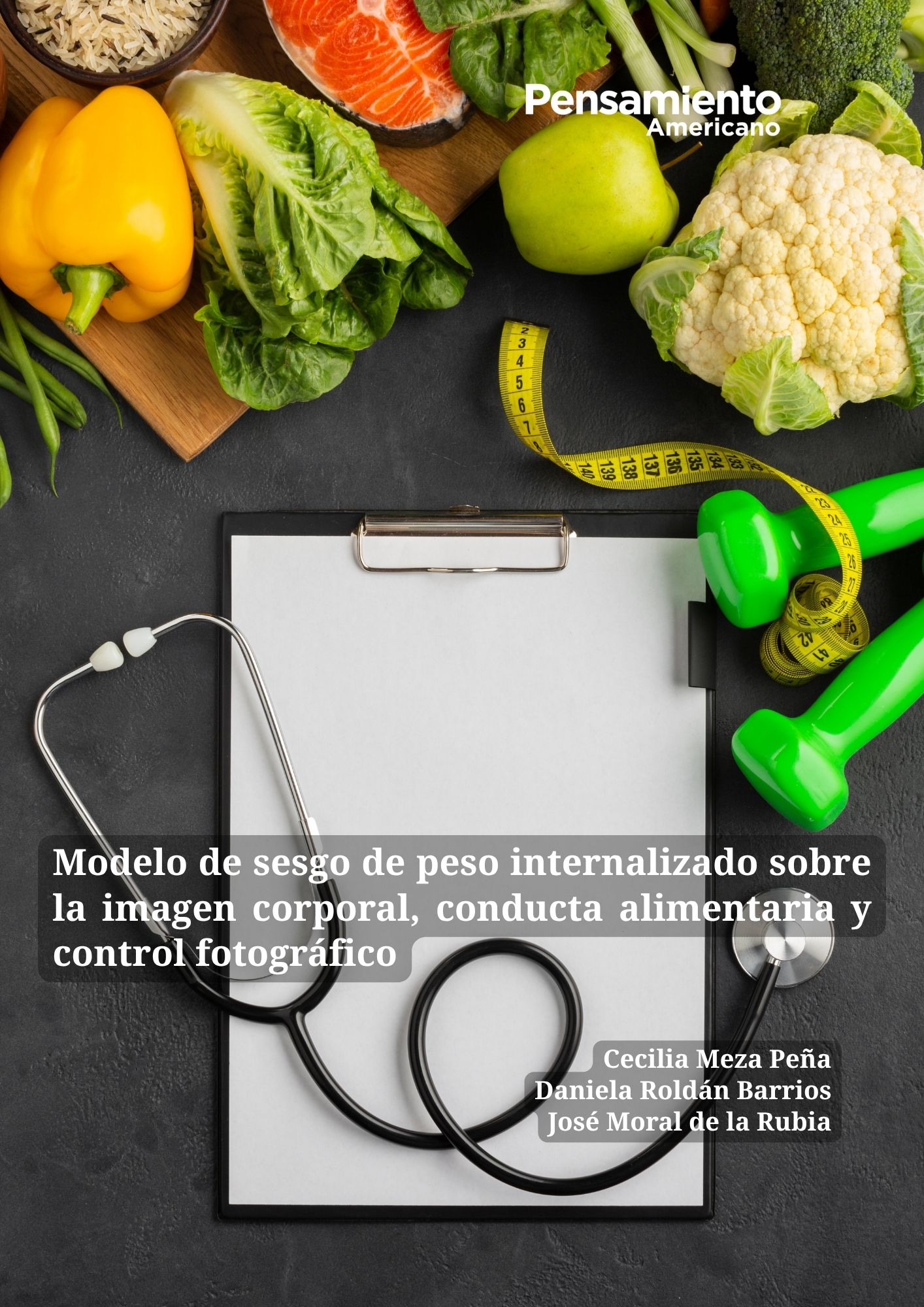
Modelo de sesgo de peso internalizado sobre la imagen corporal, conducta alimentaria y control fotográfico
DOI:
https://doi.org/10.21803/penamer.19.39.920Palabras clave:
Sesgo de peso, insatisfacción corporal, trastornos de la conducta alimentaria, AdolescenciaResumen
i) introducción: Se ha demostrado que la internalización del sesgo del peso (SPI) potencia la insatisfacción con la imagen corporal (IC), las conductas alimentarias de riesgo (CAR) y el control de la imagen corporal en fotografías (CICF); ii) objetivo: Probar un modelo que predice directamente la IC, e indirectamente predice la CAR y el BICP a través de la IC, utilizando análisis de trayectorias; iii) metodología: La muestra incluyó 187 adolescentes mexicanos, con una edad media de 13.26 años. Se utilizaron cuatro escalas validadas en español y para adolescentes. Para probar el modelo estructural se utilizó el path analysis. Para ello se realizó un análisis monogrupo y un análisis multigrupo. Ambos análisis se realizaron mediante el método de mínimos cuadrados asintóticamente libres de distribución; iv) resultados: El modelo tuvo un buen ajuste y fue validado en la muestra de un solo grupo. El análisis multigrupo reveló que el modelo es adecuado para ambos sexos, pero no es invariante. v) conclusiones: El modelo en el que SPI predice directamente IC; e indirectamente CAR y CICF a través de IC, se valida en una muestra de adolescentes mexicanos, teniendo mayor capacidad predictiva en mujeres.
Descargas
Referencias
Academy of Nutrition and Dietetics. (2020). What is disordered eating? https://www.eatright.org/health/health-conditions/eating-disorders/what-is-disordered-eating
Andrés, A., Fornieles, A., Sepúlveda, A. R., Beltrán, L., Montcada, A., Bach, A., & Sánchez, D. (2022). Spanish validation of the modified weight bias internalization scale (WBIS-M) for adolescents. Eating and Weight Disorders - Studies on Anorexia, Bulimia and Obesity, 27(8), 3245–3256. https://doi.org/10.1007/s40519-022-01453-z
Asociación Americana de Psicología. (2017). Ethical principles of psychologists and code of conduct. Artículos 8.01 y 8.02. https://www.apa.org/ethics/code/ethics-code-2017.pdf
Beltrán, L., Rojo, M., Rodríguez, L., & Sepúlveda, A. R. (2023). Weight bias internalization among adolescents in Spain: psychological correlates across gender diversity and weight status. Revista de Psicología Clínica Con Niños y Adolescentes, 10(2). https://doi.org/10.21134/rpcna.2023.10.2.5
Bentler, P. M. (1990). Comparative fit indexes in structural models. Psychological Bulletin, 107, 238‑246. http://dx.doi.org/10.1037/0033-2909.107.2.238
Bentler, P. M., & Bonett, D. G. (1980). Significance tests and goodness of fit in the analysis of covariance structures. Psychological Bulletin, 88, 588‑606. https://doi.org/10.1037/0033-2909.88.3.588
Bollen, K. A. (1986). Sample size and Bentler and Bonett’s nonnormed fit index. Psychometrika, 51, 375‑377. https://doi.org/10.1007/BF02294061
Bollen, K. A. (1989). A new incremental fit index for general structural equation models. Sociological Methods & Research, 17, 303‑316. https://doi.org/10.1177/0049124189017003004
Bollen, K. A., & Stine, R A. (1993). Bootstrapping goodness-of-fit measures in structural equation models. In K. A. Bollen & J. S. Long (Eds.), Testing structural equation models (pp. 111‑135). Newbury Park, CA: Sage.
Boursier, V., Gioia, F., & Griffiths, M. D. (2020). Objectified body consciousness, body image control in photos, and problematic social networking: The role of appearance control beliefs. Frontiers in Psychology, 11. https://doi.org/10.3389/fpsyg.2020.0014
Butt, M., Harvey, A. J., Khesroh, E., Rigby, A., & Paul, I. M. (2023). Assessment and Impact of Pediatrics Internalized Weight Bias: A Systematic review. Pediatric Obesity, 18(7). https://doi.org/10.1111/ijpo.13040
Cabaco, A. S., Urchaga, J. D., Guevara, R. M., & Moral-García, J. E. (2021). Psychopathological Risk Factors Associated with Body Image, Body Dissatisfaction and Weight-Loss Dieting in School-Age Adolescents. Children, 8(2), 105. https://doi.org/10.3390/children8020105
Cohen, R., Newton-John, T., & Slater, A. (2018). ‘selfie’-objectification: The role of selfies in self-objectification and disordered eating in young women. Computers in Human Behavior, 79, 68–74. https://doi.org/10.1016/j.chb.2017.10.027
Durso, L. E., & Latner, J. D. (2008). Understanding self-directed stigma: Development of the weight bias internalization scale. Obesity, 16(S2), S80-S86. https://doi.org/10.1038/oby.2008.448
Emmer, C., Bosnjak, M., & Mata, J. (2019). The association between Weight Stigma and Mental Health: A meta-analysis. Obesity Reviews, 21(1). https://doi.org/10.1111/obr.12935
Fisher, R. A. (1930). The moments of the distribution for normal samples of measures of departure from normality. Proceedings of the Royal Society of London, Series A: Mathematical, Physical, and Engineering Sciences, 130(812), 16‑28. https://doi.org/10.1098/rspa.1930.0185
Foster, T., Eaton, M., & Probst, Y. (2024). The relationship between internalized weight bias and biopsychosocial outcomes in children and youth: a systematic review. Journal Of Eating Disorders, 12(1). https://doi.org/10.1186/s40337-023-00959-w
Gila, A., Castro, J., Gómez, M. J., Toro, J., & Salamero, M. (1999). The body attitude test: Validation of the Spanish version. Eating and Weight Disorders - Studies on Anorexia, Bulimia and Obesity, 4(4), 175–178. https://doi.org/10.1007/bf03339733
Gioia, F., Griffiths, M. D., & Boursier, V. (2020). Adolescents’ body shame and social networking sites: The mediating effect of body image control in photos. Sex Roles, 83(11–12), 773–785. https://doi.org/10.1007/s11199-020-01142-0
Grogan, S. (2022). Introduction. En Body image: Understanding body dissatisfaction in men, women, and children (4ta ed.), Routledge. https://books.google.com.mx/books?hl=es&lr=&id=J5tIEAAAQBAJ&oi=fnd&pg=PT9&dq=body+image+definition&ots=My-I_g5EcC&sig=3EMrmJt6fRABBknmztCwstwjGH8&redir_esc=y#v=onepage&q=body%20image%20definition&f=false
Hartman-Munick, S. M., Gordon, A. R., & Guss, C. (2020). Adolescent body image: influencing factors and the clinician’s role. Current Opinion in Pediatrics, With Evaluated MEDLINE/Current Opinion in Pediatrics, 32(4), 455-460. https://doi.org/10.1097/mop.0000000000000910
Hernández, R., Fernández, C. y Baptista, P. (2014). Metodología de la investigación. Mcgrawhill, 1234567990.
Heider, N., Spruyt, A., & De Houwer, J. (2018). Body dissatisfaction revisited: On the importance of implicit beliefs about actual and ideal body image. Psychologica Belgica, 57(4), 158. https://doi.org/10.5334/pb.362
Hosseini, S., & Padhy, R. (2019). Body Image Distortion. Europe PMC. Recuperado 8 de febrero de 2024, de https://europepmc.org/article/nbk/nbk546582#article-18424.r9
Lin, C.-Y., Imani, V., Broström, A., Huus, K., Björk, M., Hodges, E. A., & Pakpour, A. H. (2019). Psychological distress and quality of life in Iranian adolescents with overweight/obesity: Mediating roles of weight bias internalization and insomnia. Eating and Weight Disorders - Studies on Anorexia, Bulimia and Obesity, 25(6), 1583–1592. https://doi.org/10.1007/s40519-019-00795-5
Jöreskog, K. G. & Sörbom, D. (1986). LISREL VI: Analysis of linear structural relationships by maximum likelihood and least square methods. Mooresville, IN: Scientific Software.
Kankainen, A., Taskinen, S., & Oja, H. (2007), Tests of multinormality based on location vectors and scatter matrices. Statistical Methods and Applications, 16, 357‑379. https://doi.org/10.1007/s10260-007-0045-9
Kirk, S. F., Ramos, X., Alberga, A. S., & Russell-Mayhew, S. (2020). Reducing weight bias in obesity management, Practice & Policy. Obesity Canada. https://obesitycanada.ca/guidelines/weightbias.
Marshall, R. D., Latner, J. D., & Masuda, A. (2020). Internalized weight bias and disordered eating: The mediating role of body image avoidance and drive for thinness. Frontiers in Psychology, 10. https://doi.org/10.3389/fpsyg.2019.02999
Meza, C., & Pompa, E. (2018). Body image distortion and dissatisfaction in a Mexican sample. Revista de Psicología y Ciencias Del Comportamiento de La Unidad Académica de Ciencias Jurídicas y Sociales, 9(2), 120–131. https://doi.org/10.29365/rpcc.20181207-75
Meza, C., & Gutiérrez, M. L. (2020). Translation and validation in Spanish of the Body Image Control in Photographs Questionnaire (BICP-S). Applied Psychology Bulletin, 58(288), 4–57. https://doi.org/10.26387/bpa.288.4
Meza, C., & Gutiérrez-Muñoz, M. L. (2023). Invarianza factorial por sexo y puntos de corte del cuestionario de control de la imagen corporal en fotografías en población mexicana. CienciaUAT, 18(1), 95-106. https://doi.org/10.29059/cienciauat.v18i1.1724
Molina, N. P. (2018). Aspectos éticos en la investigación con niños. Ciencia, Tecnología Para La Salud Visual y Ocular, 16(1), 75–87. https://doi.org/10.19052/sv.4348
Nilsson, K., Danielsson, H., Elwér, A., Messer, D., Henry, L., & Samuelsson, S. (2021). Investigating Reading Comprehension in Adolescents with Intellectual Disabilities: Evaluating the Simple View of Reading. Journal of Cognition, 4(1): 56, 1–20. https://doi.org/10.5334/joc.188
O’Hara, L., & Taylor, J. (2018). What’s wrong with the ‘War on obesity?’ A narrative review of the weight-centered health paradigm and development of the 3C framework to build critical competency for a paradigm shift. SAGE Open, 8(2), 215824401877288. https://doi.org/10.1177/2158244018772888
Pelosi, A., Zorzi, G. & Corsano, P. (2014). The “body image control in photos questionnaire” (BICP). BPA Applied Psychology Bulletin, 62 (269), 42-52. https://doi.org/10.1037/t35916-000
Pearl, R. L., Himmelstein, M. S., Puhl, R. M., Wadden, T. A., Wojtanowski, A. C., & Foster, G. D. (2019). Weight bias internalization in a commercial weight management sample: Prevalence and correlates. Obesity Science & Practice, 5(4), 342–353. https://doi.org/10.1002/osp4.354
Puhl, R. M., & Himmelstein, M. S. (2018). Weight bias internalization among adolescents seeking weight loss: Implications for eating behaviors and parental communication. Frontiers in Psychology, 9. https://doi.org/10.3389/fpsyg.2018.02271
Pearl, R. L., & Puhl, R. M. (2018). Weight bias internalization and Health: A Systematic Review. Obesity Reviews, 19(8), 1141–1163. https://doi.org/10.1111/obr.12701
Probst, M., Vandereycken, W., Coppenolle, H. V., & Vanderlinden, J. (1995). The body attitude test for patients with an eating disorder: Psychometric characteristics of a new questionnaire. Eating Disorders, 3(2), 133–144. https://doi.org/10.1080/10640269508249156
Quittkat, H. L., Hartmann, A. S., Düsing, R., Buhlmann, U., & Vocks, S. (2019). Body dissatisfaction, importance of appearance, and body appreciation in men and women over the lifespan. Frontiers in Psychiatry, 10. https://doi.org/10.3389/fpsyt.2019.00864
Romano, K. A., Heron, K. E., & Henson, J. M. (2021). Examining associations among weight stigma, weight bias internalization, body dissatisfaction, and eating disorder symptoms: Does weight status matter? Body Image, 37, 38–49. https://doi.org/10.1016/j.bodyim.2021.01.006
Royston, J. P. (1992). Approximating the Shapiro-Wilk W-test for non-normality. Statistics and Computing, 2(3), 117‑119. https://doi.org/10.1007/BF01891203
Rubino, F., Puhl, R. M., Cummings, D. E., Eckel, R. H., Ryan, D. H., Mechanick, J. I., Nadglowski, J., Ramos Salas, X., Schauer, P. R., Twenefour, D., Apovian, C. M., Aronne, L. J., Batterham, R. L., Berthoud, H.-R., Boza, C., Busetto, L., Dicker, D., De Groot, M., Eisenberg, D., … Dixon, J. B. (2020). Joint International Consensus Statement for Ending Stigma of obesity. Nature Medicine, 26(4), 485–497. https://doi.org/10.1038/s41591-020-0803-x
Snow, P. C., Graham, L. J., Mclean, E. J., & Serry, T. A. (2019). The oral language and reading comprehension skills of adolescents in flexible learning programmes. International Journal of Speech-language Pathology, 22(4), 425-434. https://doi.org/10.1080/17549507.2019.1652343
Sociedad Mexicana de Psicología. (2010). Código ético del psicólogo. Trillas.
Steiger, J. H., & Lind, J. M. (1980, June). Statistically based tests for the number of common factors. Paper presented at the annual meeting of the Psychometric Society, Iowa City, IA.
Unikel, C., Bojórquez, I., & Carreño, S. (2004). Validación de un cuestionario breve para medir conductas alimentarias de riesgo. Salud Pública De México, 46(6) 509-515. https://www.saludpublica.mx/index.php/spm/article/view/6572/8096
Unikel, C., Díaz de León, C., & Rivera, J. (2017). Conductas alimentarias de riesgo y factores asociados: desarrollo y validación de instrumentos de medición (1.a ed., Vol. 129) [Ebook]. Universidad Autónoma Metropolitana.
Vargas, R., Bautista, M. L., & Palencia, A. R. (2021). Conductas alimentarias de riesgo e insatisfacción corporal en adolescentes de secundaria: el papel del sexo y ubicación de la escuela. Educación y Salud Boletín Científico Instituto de Ciencias de la Salud Universidad Autónoma del Estado de Hidalgo, 9(18), 11-19. https://doi.org/10.29057/icsa.v9i18.6571
Descargas
Publicado
Número
Sección
Licencia
Derechos de autor 2026 Pensamiento Americano

Esta obra está bajo una licencia internacional Creative Commons Atribución-NoComercial-SinDerivadas 4.0.
Bajo las condiciones siguientes:
-
Reconocimiento — Debe reconocer adecuadamente la autoría, proporcionar un enlace a la licencia e indicar si se han realizado cambios<. Puede hacerlo de cualquier manera razonable, pero no de una manera que sugiera que tiene el apoyo del licenciador o lo recibe por el uso que hace.
-
NoComercial — No puede utilizar el material para una finalidad comercial.
-
SinObraDerivada — Si remezcla, transforma o crea a partir del material, no puede difundir el material modificado.
- No hay restricciones adicionales — No puede aplicar términos legales o medidas tecnológicas que legalmente restrinjan realizar aquello que la licencia permite.