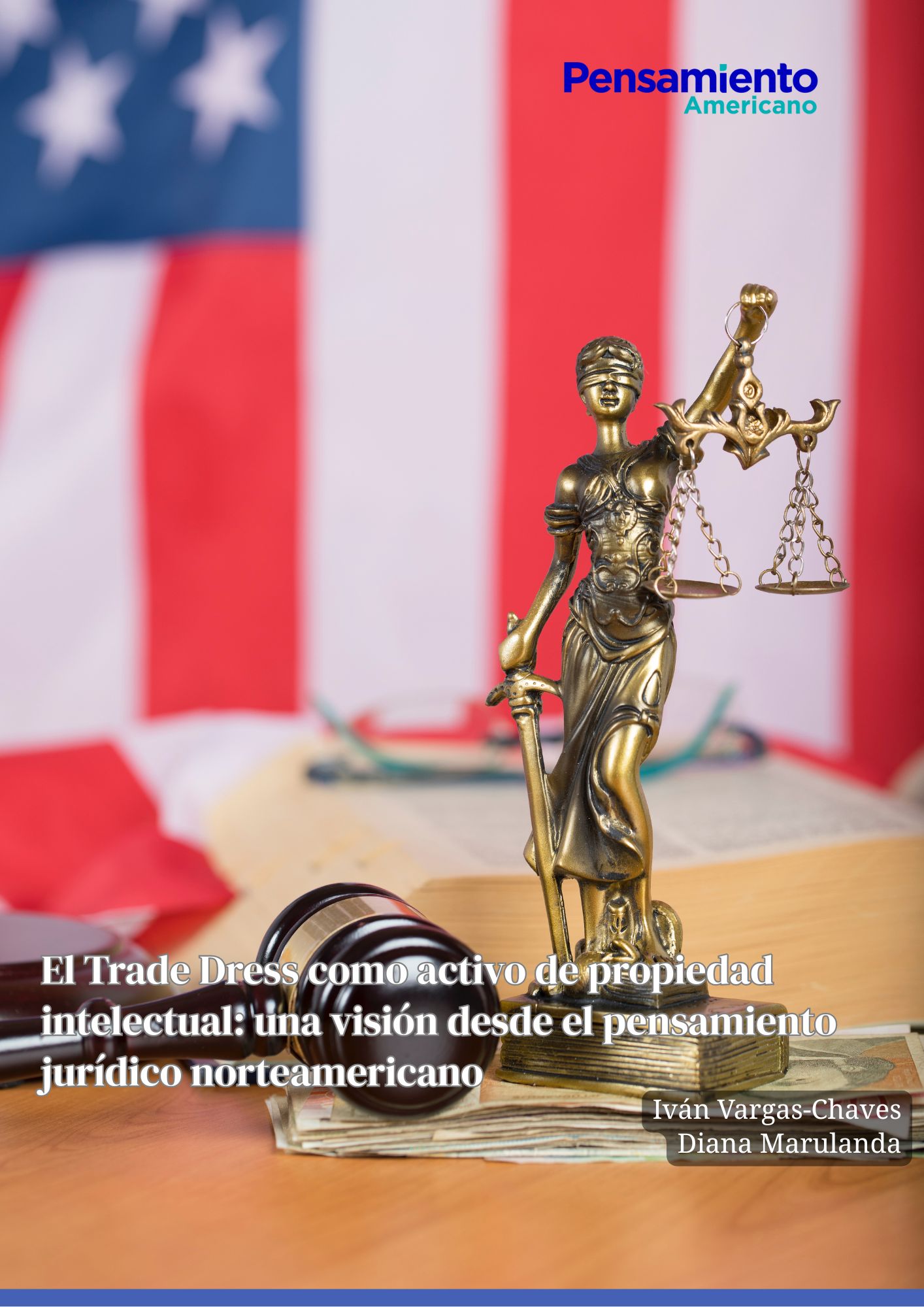
El Trade Dress como activo de propiedad intelectual: unavisión desde el pensamiento jurídico norteamericanoto jurídico norteamericanode el pensamiento jurídico norteamericano
DOI:
https://doi.org/10.21803/penamer.18.38.888Palabras clave:
Trade Dress, Propiedad Intelectual, Pensamiento Jurídico Norteamericano, Competencia Desleal, Marcas TridimensionalesResumen
Introducción: El Trade Dress, entendido como el conjunto de elementos visuales distintivos de un producto o establecimiento, es un valioso activo intangible para las empresas. No en vano, aunque existen diversas vías legales para su protección,
como el derecho de autor, los diseños industriales o la competencia desleal, estas presentan limitaciones significativas en cuanto a su duración y alcance probatorio. Objetivo: Analizar con un enfoque en el pensamiento jurídico norteamericano, cuál
es la vía de protección más efectiva para el Trade Dress. Metodología: Se utilizó un enfoque hermenéutico-sistemático y un análisis documental de doctrina y jurisprudencia de bases de datos como Scopus y JSTOR, seleccionando la doctrina estadounidense por ser pionera en este campo. Resultados: El análisis de las diferentes soluciones y de casos emblemáticos de EE. UU. demostró que la protección del Trade Dress, ya sea en el ámbito de la arquitectura o en el diseño de empaques, depende de los requisitos de distintividad y no funcionalidad. Conclusiones: La protección a través de signos distintivos, específicamente las marcas tridimensionales, se presenta como la vía más efectiva y duradera. Esta estrategia no solo resguarda la inversión empresarial, sino que también previene la confusión del consumidor y facilita la construcción de una identidad de marca sólida.
Descargas
Referencias
Barrett, M. (2004). Consolidating the Diffuse Paths to Trade Dress Functionality: Encountering TrafFix on the Way to Sears. WASh. & lee l. reV., 61, 79. https://scholarlycommons.law.wlu.edu/wlulr/vol61/iss1/3/
Berzins, I. K. (2003). The Emerging Circuit Split over Secondary Meaning in Trade Dress Law. U. Pa. L. Rev., 152, 1661. https://scholarship.law.upenn.edu/penn_law_review/vol152/iss5/3
Byerly, L. M. (1998). Look and Feel Protection of Web Site User Interfaces: Copyright or Trade Dress? Santa Clara Computer & High Tech. LJ, 14, 221. https://digitalcommons.law.scu.edu/chtlj/vol14/iss1/4
Cohen, A. B. (2009). Following the direction of Traffix: Trade dress law and functionality revisited. Idea, 50, 593. https://digitalcommons.law.wne.edu/facschol/82/
Davis Jr, T. H. (1995). Copying in the Shadow of the Constitution: The Rational Limits of Trade Dress Protection. Minn. L. Rev., 80, 595. https://scholarship.law.umn.edu/mlr/2408/
De Almeida, X. V. (2015). As possibilidades de proteção ao trade dress. Direito & Justiça, 41(2), 248-263. https://doi.org/10.15448/1984-7718.2015.2.13642
De Carvalho Leal, V., Teixeira-Esteves, J., Montesinos-Padilha, C., Vargas-Chaves, I., & Uscanga-Barradas, A. (2018). Conflitos e novos desafios do direito: Política, meio ambiente e novas tecnologias. Editora RTM / Universidade Federal de Pernambuco
Dinwoodie, G. B. (1996). Reconceptualizing the inherent distinctiveness of product design trade dress. NCL Rev., 75, 471. http://dx.doi.org/10.4324/9781003376040
Dinwoodie, G. B., Janis, M. D., & Du Mont, J. (2024). Trade dress and design law. Aspen Publishing.
Dowell, A. E. (1994). Trade Dress Protection of Product Designs: Stifling the Progress of Science and the Useful Arts for an Unlimited Time. Notre Dame L. Rev., 70, 137. https://scholarship.law.nd.edu/ndlr/vol70/iss1/4/
Dratler Jr, J. (1996). Trade Dress Protection for Product Configurations: Is There a Conflict With Patent Policy. AIPLA QJ, 24, 427. https://works.bepress.com/jay_dratler/4/
Edelstein, J. S., & Lueders, C. L. (2000). Recent Developments in Trade Dress Infrigement Law. IDEA, 40, 105. https://ipmall.info/sites/default/files/hosted_resources/IDEA/4.Edelstein00.pdf
Finch, A. C. (1996). When imitation is the sincerest form of flattery: Private label products and the role of intention in determining trade dress infringement. The University of Chicago Law Review, 63(3), 1243-1276. https://chicagounbound.uchicago.edu/uclrev/vol63/iss3/9/
García Velasco, I. C. (2017). Trade dress, imagen empresarial o apariencia distintiva: como objeto de protección dentro de una franquicia. Revista Republicana, 22, 231-257. http://dx.doi.org/10.21017/Rev.Repub.2017.v22.a27
Gaske, W. F. (1988). Trade Dress Protection: Inherent Distinctiveness as an Alternative to Secondary Meaning. Fordham L. Rev., 57, 1123. https://ir.lawnet.fordham.edu/flr/vol57/iss6/17/
Gleiberman, M. R. (1993). From Fast Cars to Fast Food: Overbroad Protection of Product Trade Dress Under Section 43 (a) of the Lanham Act. Stanford Law Review, 2037-2072.
Greene, J. A., & Kesselheim, A. S. (2011). Why do the same drugs look different? Pills, trade dress, and public health. New England Journal of Medicine, 365(1), 83-89. http://dx.doi.org/10.1056/NEJMhle1101722
Hammersley, F. M. (1998). The smell of success: Trade dress protection for scent marks. Marq. Intell. Prop. L. Rev., 2, 105. https://scholarship.law.marquette.edu/iplr/vol2/iss1/4/
Harvey, M., Rothe, J. T., & Lucas, L. A. (1998). The “trade dress” controversy: A case of strategic cross-brand cannibalization. Journal of Marketing Theory and Practice, 6(2), 1-15. https://doi.org/10.1080/10696679.1998.11501791
Horta, R. J. (1993). Without Secondary Meaning, Do Product Design Trade Dress Protections Function as Infinite Patents. Suffolk UL Rev., 27, 113.
Japanese Intellectual Property High Court, Case No. 10215, 2007, Sentencia de 29 de mayo de 2008.
Karki, M. (2005). Nontraditional areas of intellectual property protection: Colour, sound, taste, smell, shape, slogan and trade dress. Journal of Intellectual Property Rights, 10. 499-506.
Kellner, L. F. (1994). Trade Dress Protection for Computer User Interface Look and Feel. U. Chi. L. Rev., 61, 1011. https://chicagounbound.uchicago.edu/cgi/viewcontent.cgi?article=4841&context=uclrev
Kratzke, W. P. (2001). The Supreme Court and Trade Dress-A Short Comment. Hastings Comm. & Ent. LJ, 24, 73. https://repository.uclawsf.edu/hastings_comm_ent_law_journal/vol24/iss1/3/
Lunney Jr, G. S. (1999). The Trade Dress Emperor's New Clothes: Why Trade Dress Does Not Belong on the Principal Register. Hastings LJ, 51, 1131. https://scholarship.law.tamu.edu/facscholar/552/
Opderbeck, D. W. (1999). An Economic Perspective on Product Configuration Trade Dress. Seton Hall Legis. J., 24, 327. https://scholarship.shu.edu/shlj/vol24/iss2/5/
Perez, M. S. (1995). Reconciling the Patent Act and the Lanham Act: Should Product Configurations Be Entitled to Trade Dress Protection after the Expiration of a Utility or Design Patent. Tex. Intell. Prop. LJ, 4, 383. https://tiplj.org/wp-content/uploads/Volumes/v4/v4p383.pdf
Prowda, J. B. (1997). The Trouble with Trade Dress Protection of Product Design. Alb. L. Rev., 61, 1309.
Ramírez-Montes, C. J. (2019). The elusive distinctiveness of trade dress in EU trademark law. Emory Int'l L. Rev., 34, 277. https://scholarlycommons.law.emory.edu/eilr/vol34/iss1/2/
Rogers, E. (1914). Good Will, trademarks and unfair trading. A. W. Shaw Company.
Sandberg, S. C. (2009). Trade Dress: what does it mean. Franchise LJ, 29, 10.
Schultz, A. B. (1976). Trade Dress and Unfair Competition in Publishing and Packaging. Brook. L. Rev., 43, 654.
Shpetner, M. A. (1997). Determining a proper test for inherent distinctiveness in trade dress. Fordham Intell. Prop. Media & Ent. LJ, 8, 947. https://ir.lawnet.fordham.edu/iplj/vol8/iss3/6
Shroder, W. J. (1911). Price Restriction on the Re-sale of Chattels. Harvard Law Review, 25(1), 59-69. https://doi.org/10.2307/1324997
Smith, L. (2005). Trade Distinctiveness: Solving Scalia's Tertium Quid Trade Dress Conundrum. Mich. St. L. Rev., 243. https://papers.ssrn.com/sol3/papers.cfm?abstract_id=916553
Straus, N. (2012). Trade dress protection for cuisine: Monetizing creativity in a low-IP industry. UCLA L. Rev., 60, 182. https://www.uclalawreview.org/trade-dress-protection-for-cuisine-monetizing-creativity-in-a-low-ip-industry/
Supreme Court of the United States, Owens-Corning Fiberglas Corporation, 1995. https://law.resource.org/pub/us/case/reporter/F2/774/774.F2d.1116.84- 1416.html
Supreme Court of the United States, Publications International, Ltd., v. Landoll, Inc., 1998. http://caselaw.findlaw.com/us-7th-circuit/1179464.html
Supreme Court of the United States, Qualitex Co. v. Jacobson Products Co., 1995. https://www.law.cornell.edu/supct/html/93-1577.ZO.html
Supreme Court of the United States, Two Pesos Inc., 1992. https://supreme.justia.com/cases/federal/us/505/763/case.html
Supreme Court of the United States, Walmart Stores, Inc. v. Samara Brothers, Inc., 2000. https://www.law.cornell.edu/supct/html/99-150.ZO.html
Terakura, K. K. (2000). Insufficiency of trade dress protection: Lack of guidance for trade dress infringement litigation in the fashion design industry. U. Haw. L. Rev., 22, 569.
The Embellished Life (2011). What I’m Reading in Fashion News: The Louboutin YSL Case. https://theembellishedlifeblog.wordpress.com/2011/09/30/what-im-reading-in-fashion-news-the-louboutin-ysl-case/
Tribunal de Justicia de la Comunidad Andina, 141-IP-2016.
Warlop, L., & Alba, J. W. (2004). Sincere flattery: Trade-dress imitation and consumer choice. Journal of consumer Psychology, 14(1-2), 21-27. https://doi.org/10.1207/s15327663jcp1401&2_4
Welkowitz, D. S. (1998). Trade Dress and Patent-The Dilemma of Confusion. Rutgers LJ, 30, 289. https://papers.ssrn.com/sol3/papers.cfm?abstract_id=178348
Wong, M. M. (1997). Aesthetic Funtionality Doctrine and the Law of Trade-Dress Protection. Cornell L. Rev., 83, 1116. : http://scholarship.law.cornell.edu/clr/vol83/iss4/5
Descargas
Publicado
Número
Sección
Licencia
Derechos de autor 2025 Pensamiento Americano

Esta obra está bajo una licencia internacional Creative Commons Atribución-NoComercial-SinDerivadas 4.0.
Bajo las condiciones siguientes:
-
Reconocimiento — Debe reconocer adecuadamente la autoría, proporcionar un enlace a la licencia e indicar si se han realizado cambios<. Puede hacerlo de cualquier manera razonable, pero no de una manera que sugiera que tiene el apoyo del licenciador o lo recibe por el uso que hace.
-
NoComercial — No puede utilizar el material para una finalidad comercial.
-
SinObraDerivada — Si remezcla, transforma o crea a partir del material, no puede difundir el material modificado.
- No hay restricciones adicionales — No puede aplicar términos legales o medidas tecnológicas que legalmente restrinjan realizar aquello que la licencia permite.