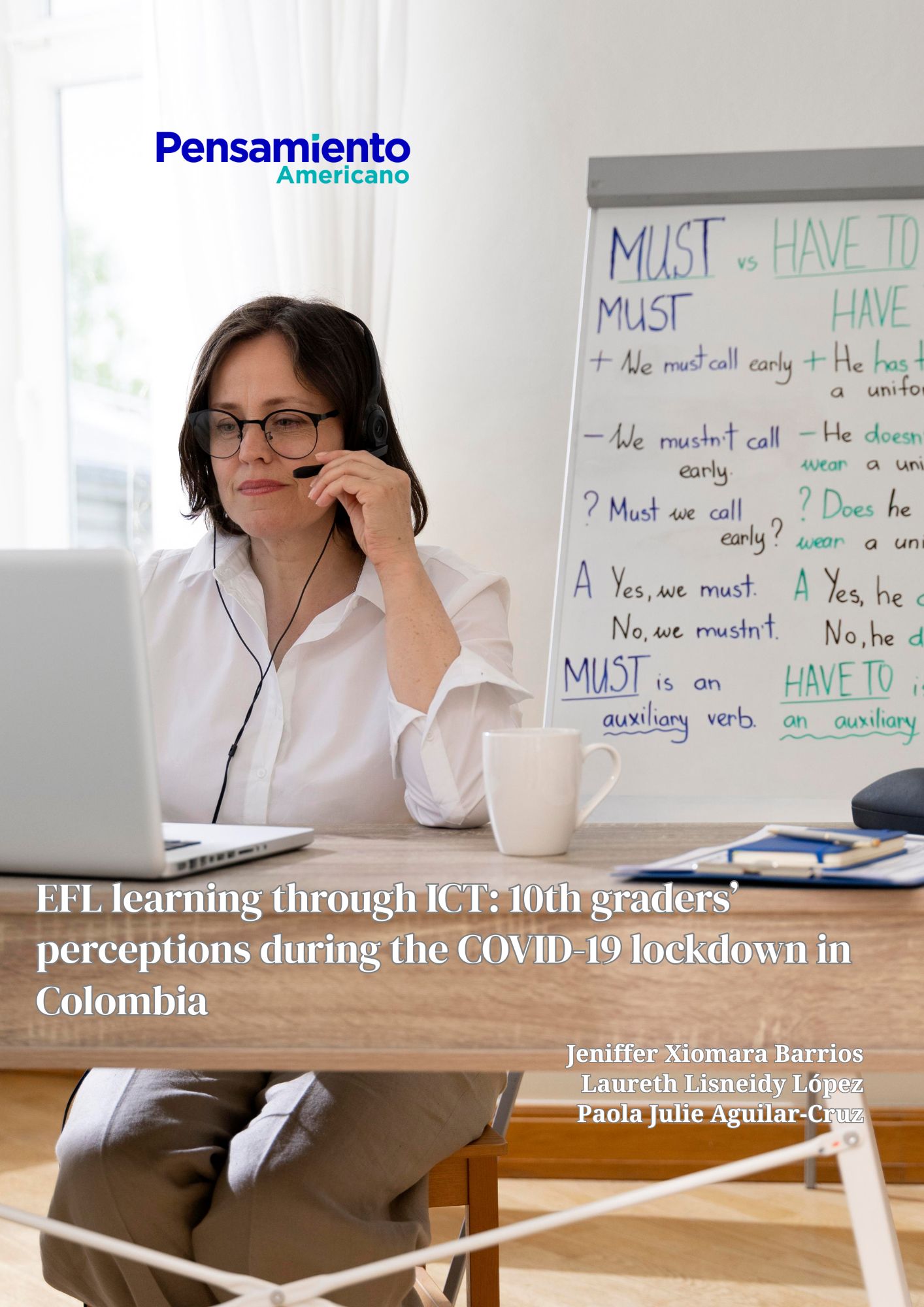
Aprendizaje del inglés mediante TIC: Percepciones de estudiantes de 10° durante el confinamiento por COVID-19 en Colombia
DOI:
https://doi.org/10.21803/penamer.18.38.891Palabras clave:
Aprendizaje de EFL, herramientas TIC, educación en línea, percepcioens de estudiantes, COVID-19Resumen
Introducción: La pandemia de COVID-19 transformó significativamente la educación, haciendo que el aprendizaje en línea y el uso de herramientas TIC fueran esenciales para la continuidad académica. Objetivo: Este estudio explora las percepciones de los estudiantes de décimo grado sobre su proceso de aprendizaje del inglés como lengua extranjera (EFL) mediado por herramientas TIC durante el confinamiento, identificando tanto desafíos como beneficios. Metodología: El estudio empleó un diseño de métodos mixtos con un alcance descriptivo, recopilando datos mediante una encuesta y entrevistas semiestructuradas para integrar los resultados cuantitativos con las percepciones cualitativas. Resultados: Los hallazgos indican que, aunque los estudiantes reconocieron la importancia de aprender inglés, enfrentaron dificultades para desarrollar habilidades comunicativas debido a la limitada interacción. La motivación y la confianza para hablar inglés variaron, y muchos tuvieron dificultades para participar activamente. El papel de los docentes y las herramientas digitales fue percibido como un apoyo, pero también como una limitación, dependiendo de la disponibilidad de recursos y la orientación estructurada. Problemas técnicos, como interrupciones de internet, también afectaron la participación. Conclusiones: las herramientas TIC fueron fundamentales para mantener la enseñanza del inglés durante la pandemia, pero no lograron replicar completamente las interacciones dinámicas del aula. Se sugiere que futuras investigaciones se centren en integrar estrategias más interactivas y personalizadas para mejorar el aprendizaje del idioma en línea.
Descargas
Referencias
Aguilar-Cruz, P. J., & Medina, D. L. (2021). Pre-service English teachers’ perceptions of their online teaching practice during pandemic times. Propósitos y Representaciones, 9(SPE1). https://doi.org/10.20511/pyr2021.v9nSPE1.925
Ajaka, L. (2020). EFL: An exploration of the novel aspects of learning and using English as a Foreign Language. CALR Linguistics Journal - Issue 10. https://doi.org/10.60149/WCAU2014
Akram, A., Nazir, M., Batool, T., Zulfiqar, M. I., Zulfiqar, M. I., Nazir, M., Nazir, M., Azhar, H., Azhar, H., Murawwat, S., & Murawwat, S. (2021). Comparative review on information and communication technology issues in education sector of developed and developing countries: a case study about Pakistan. Bulletin of Electrical Engineering and Informatics, 10(6), 3489–3500. https://doi.org/10.11591/eei.v10i6.3245
Aldawi, F., & Maher, A. (2023). The Role of Google Docs in Enhancing Collaborative Writing in Higher Education Institutions. 2023 IEEE 3rd International Maghreb Meeting of the Conference on Sciences and Techniques of Automatic Control and Computer Engineering (MI-STA), 266–269. https://doi.org/10.1109/MI-STA57575.2023.10169399
Alhassan, Y., McChristie, S., & Paul, G. (2023). The Effect of the COVID-19 Lockdown on Learning and Teaching (pp. 1–25). https://doi.org/10.4018/978-1-6684-8332-9.ch001
Alonso, A. (2020). Fostering the Teaching of Cultural Vocabulary in EFL Contexts. In Vocabulary in Curriculum Planning (pp. 183–198). Springer International Publishing. https://doi.org/10.1007/978-3-030-48663-1_10
Amorim, G. B., Có, E. P., & Finardi, K. R. (2021). PERCEPÇÕES DE ALUNOS SOBRE OS IMPACTOS DA PANDEMIA NA EDUCAÇÃO: FOCO NO APRENDIZADO DE INGLÊS. Revista Prâksis, 3, 4–31. https://doi.org/10.25112/rpr.v3.2563
Apriani, E., Arsyad, S., Syafryadin, S., Supardan, D., Gusmuliana, P., & Santiana, S. (2022). ICT platforms for Indonesian EFL students viewed from gender during the COVID-19 pandemic. Studies in English Language and Education, 9(1), 187–202. https://doi.org/10.24815/siele.v9i1.21089
Ariyanti, A. (2020). EFL Students’ Challenges towards Home Learning Policy During Covid-19 Outbreak. IJELTAL (Indonesian Journal of English Language Teaching and Applied Linguistics), 5(1), 167. https://doi.org/10.21093/ijeltal.v5i1.649
Barrot, J., Agdeppa, J., & Manzano, B. (2024). What It Takes to Teach in a Fully Online Learning Environment: Provisional Views from a Developing Country. Online Learning, 28(1). https://doi.org/10.24059/olj.v28i1.3921
Bozorgian, H. (2012). The Relationship between Listening and Other Language Skills in International English Language Testing System. Theory and Practice in Language Studies, 2(4). https://doi.org/10.4304/tpls.2.4.657-663
Chen, J.-M., Chen, M.-C., & Sun, Y. S. (2010). A novel approach for enhancing student reading comprehension and assisting teacher assessment of literacy. Computers & Education, 55(3), 1367–1382. https://doi.org/10.1016/j.compedu.2010.06.011
Correa, D., & González, A. (2016). English in public primary schools in Colombia: Achievements and challenges brought about by national language education policies. Education Policy Analysis Archives, 24, 83. https://doi.org/10.14507/epaa.24.2459
Creswell, J. (2012). Educational Research: planning, conducting and evaluating quantitative and qualitative research: Vol. 4th edition. Pearson Education, Inc.
De-la-Hoz-Franco, E., Martínez-Palmera, O., Combita-Niño, H., & Hernández-Palma, H. (2019). Las Tecnologías de la Información y la Comunicación y su Influencia en la Transformación de la Educación Superior en Colombia para Impulso de la Economía Global. Información Tecnológica, 30(1), 255–262. https://doi.org/10.4067/S0718-07642019000100255
Erbeli, F., & Joshi, R. M. (2022). Simple view of reading among Slovenian English foreign language learners: A latent interaction modeling approach. Learning and Individual Differences, 93, 101958. https://doi.org/10.1016/j.lindif.2020.101958
Fathi, J., & Rahimi, M. (2024). Utilising artificial intelligence-enhanced writing mediation to develop academic writing skills in EFL learners: a qualitative study. Computer Assisted Language Learning. https://doi.org/10.1080/09588221.2024.2374772
Felke, T. P., & Menon, G. M. (2011). Using Technology for International Education and Research. In Handbook of International Social WorkHuman Rights, Development, and the Global Profession (pp. 349–355). Oxford University Press. https://doi.org/10.1093/acprof:oso/9780195333619.003.0053
Fukuda, S. T., Lander, B. W., & Pope, C. J. (2024). EXPLORING STUDENT ENGAGEMENT WITH FORMATIVE ASSESSMENT AND ICT TOOLS. LLT Journal: A Journal on Language and Language Teaching, 27(2), 911–930. https://doi.org/10.24071/llt.v27i2.9092
Hakim, B. (2021). Role of ICT in the Process of EFL Teaching and Learning in an Arab Context. Humanities and Social Sciences Letters, 9(1), 58–71. https://doi.org/10.18488/journal.73.2021.91.58.71
Hampel, R., & Pleines, C. (2013). Fostering S tudent I nteraction and E ngagement in a V irtual L earning E nvironment: A n I nvestigation into A ctivity D esign and I mplementation. CALICO Journal, 30(3), 342–370. https://doi.org/10.11139/cj.30.3.342-370
Hernández, G. E., Trujillo, J. M., Cáceres, M. P., & Soler, R. (2018). Using and integration of ICT in a diverse educational context of Santander (Colombia). Journal of Technology and Science Education, 8(4), 254. https://doi.org/10.3926/jotse.314
Huang, R., Spector, J. M., & Yang, J. (2019). Educational Technology. Springer Singapore. https://doi.org/10.1007/978-981-13-6643-7
Iregui-Parra, P., Yepes García, A. D., Bautista-Ramírez, L. E., Hoyos Daza, D. S., & Molano-Pinán, S. Y. (2024). Challenges in the Colombian education system: the case of Mochuelo Bajo (southern Bogotá)ogotá). Revista Latinoamericana de Ciencias Sociales, Niñez y Juventud, 22(3), 1–22. https://doi.org/10.11600/rlcsnj.22.3.6143
Krath, J., Schürmann, L., & von Korflesch, H. F. O. (2021). Revealing the theoretical basis of gamification: A systematic review and analysis of theory in research on gamification, serious games and game-based learning. Computers in Human Behavior, 125, 106963. https://doi.org/10.1016/j.chb.2021.106963
Lezama, E., Echegaray, S., Medina, M., Destre, P., & Ninaquispe-Soto, M. (2023). Appropriation of Information Technologies During Remote University Education in Latin America. In T. J. , M. R. A. R. Larrondo Petrie M.M. (Ed.), 21st LACCEI International Multi-Conference for Engineering, Education and Technology, LACCEI .
Li, G., Sun, Z., & Jee, Y. (2019). The more technology the better? A comparison of teacher-student interaction in high and low technology use elementary EFL classrooms in China. System, 84, 24–40. https://doi.org/10.1016/j.system.2019.05.003
Li, L., & Kim, M. (2024). It is like a friend to me: Critical usage of automated feedback systems by self-regulating English learners in higher education. Australasian Journal of Educational Technology, 40(1), 1–18. https://doi.org/10.14742/ajet.8821
Maphalala, M. C., Khumalo, N. P., & Khumalo, N. P. (2021). Student teachers’ experiences of the emergency transition to online learning during the Covid-19 lockdown at a South African university. Perspectives in Education, 39(3), 30–43. https://doi.org/10.18820/2519593X/pie.v39.i3.4
Marulanda, C. E., Giraldo, J., & López, M. (2014). Acceso y uso de las Tecnologías de la información y las Comunicaciones (TICs) en el aprendizaje: El Caso de los Jóvenes Preuniversitarios en Caldas, Colombia. Formación Universitaria, 7(4), 47–56. https://doi.org/10.4067/S0718-50062014000400006
Mashhadi, A., Al Suraifi, A., & Fahad, A. K. (2022). Iraqi EFL Learners’ Preferences and Readiness for Mobile Learning in Higher Education during COVID-19 Pandemic. Journal of English Language Teaching and Learning, 14(30), 351–365.
Ministry of ICT. (n.d.). Tecnologías de la Información y las Comunicaciones (TIC). Retrieved February 23, 2025, from https://mintic.gov.co/portal/inicio/Glosario/T/5755:Tecnologias-de-la-Informacion-y-las-Comunicaciones-TIC
Moodley, K., & Segoete, N. (2024). A Systematic Literature Review on the Impact of the COVID-19 Pandemic on Digital Access and the Digital Divide in South African Higher Education (pp. 113–128). https://doi.org/10.1007/978-981-97-3305-7_9
Nagashibaevna, Y. K. (2019). Students’ Lack of Interest: How to Motivate Them? Universal Journal of Educational Research, 7(3), 797–802. https://doi.org/10.13189/ujer.2019.070320
Polakova, P., & Ivenz, P. (2024). The impact of ChatGPT feedback on the development of EFL students’ writing skills. Cogent Education, 11(1). https://doi.org/10.1080/2331186X.2024.2410101
Poveda-Pineda, D. F., & Cifuentes-Medina, J. E. (2020). Incorporación de las tecnologías de información y comunicación (TIC) durante el proceso de aprendizaje en la educación superior. Formación Universitaria, 13(6), 95–104. https://doi.org/10.4067/S0718-50062020000600095
Raynal, A., & Light, D. (2021). Appropriating WhatsApp for Learning: How Preschool Families Increased Their Voices in Remote Instruction. 2021 Machine Learning-Driven Digital Technologies for Educational Innovation Workshop, 1–7. https://doi.org/10.1109/IEEECONF53024.2021.9733777
Rodríguez Arenas, J. L., & Gamboa, L. F. (2024). Does access to ICTs equally matter for men and women in terms of academic exam performance? The case of middle education in Colombia. Revista de Economía Del Rosario, 26(2), 1–32. https://doi.org/10.12804/revistas.urosario.edu.co/economia/a.14427
Rubio-Cancino, E. M., & Martínez-Bohórquez, Y. M. (2023). Educational Policies in the Process of Language Teaching and Learning in Colombia: Challenges Emerging from the Implementation of Bilingual Plans in Bogotá. In Unauthorized Outlooks on Second Languages Education and Policies (pp. 35–53). Springer International Publishing. https://doi.org/10.1007/978-3-031-45051-8_3
Siteneski, A., de la Cruz-Velez, M., Montes-Escobar, K., Duran-Ospina, J. P., Fonseca-Restrepo, C., Barreiro-Linzán, M. D., Campos García, G. A., & Gil-Mohapel, J. (2024). Effects of Transition from Remote to In-Person Learning in University Students: A Longitudinal Study. European Journal of Investigation in Health, Psychology and Education, 14(6), 1786–1802. https://doi.org/10.3390/ejihpe14060118
Tomlinson, B. (2005). English as a Foreign Language: Matching Procedures to the Context of Learning. In Handbook of Research in Second Language Teaching and Learning (pp. 161–178). Routledge. https://doi.org/10.4324/9781410612700-14
Villalba, K., Robles, H., Kholis, A., Llinas, H., & Villanueva, E. (2024). Emergency Remote EFL Learning, A Post-Pandemic Analysis of Indonesian and Colombian Students’ Perceptions: A Quantitative Study. Nanotechnology Perceptions, 20(S6). https://doi.org/10.62441/nano-ntp.v20iS6.88
Yang, H., Kim, H., Lee, J. H., & Shin, D. (2022). Implementation of an AI chatbot as an English conversation partner in EFL speaking classes. ReCALL, 34(3), 327–343. https://doi.org/10.1017/S0958344022000039
Zhang, D., & Wu, J. G. (2023). Enhancing EFL Learners’ Native Cultural Awareness via Project-based Learning. Teaching English as a Second or Foreign Language--TESL-EJ, 27(1). https://doi.org/10.55593/ej.27105int
Descargas
Publicado
Número
Sección
Licencia
Derechos de autor 2025 Pensamiento Americano

Esta obra está bajo una licencia internacional Creative Commons Atribución-NoComercial-SinDerivadas 4.0.
Bajo las condiciones siguientes:
-
Reconocimiento — Debe reconocer adecuadamente la autoría, proporcionar un enlace a la licencia e indicar si se han realizado cambios<. Puede hacerlo de cualquier manera razonable, pero no de una manera que sugiera que tiene el apoyo del licenciador o lo recibe por el uso que hace.
-
NoComercial — No puede utilizar el material para una finalidad comercial.
-
SinObraDerivada — Si remezcla, transforma o crea a partir del material, no puede difundir el material modificado.
- No hay restricciones adicionales — No puede aplicar términos legales o medidas tecnológicas que legalmente restrinjan realizar aquello que la licencia permite.